
Bob Boyer (1948–2004)
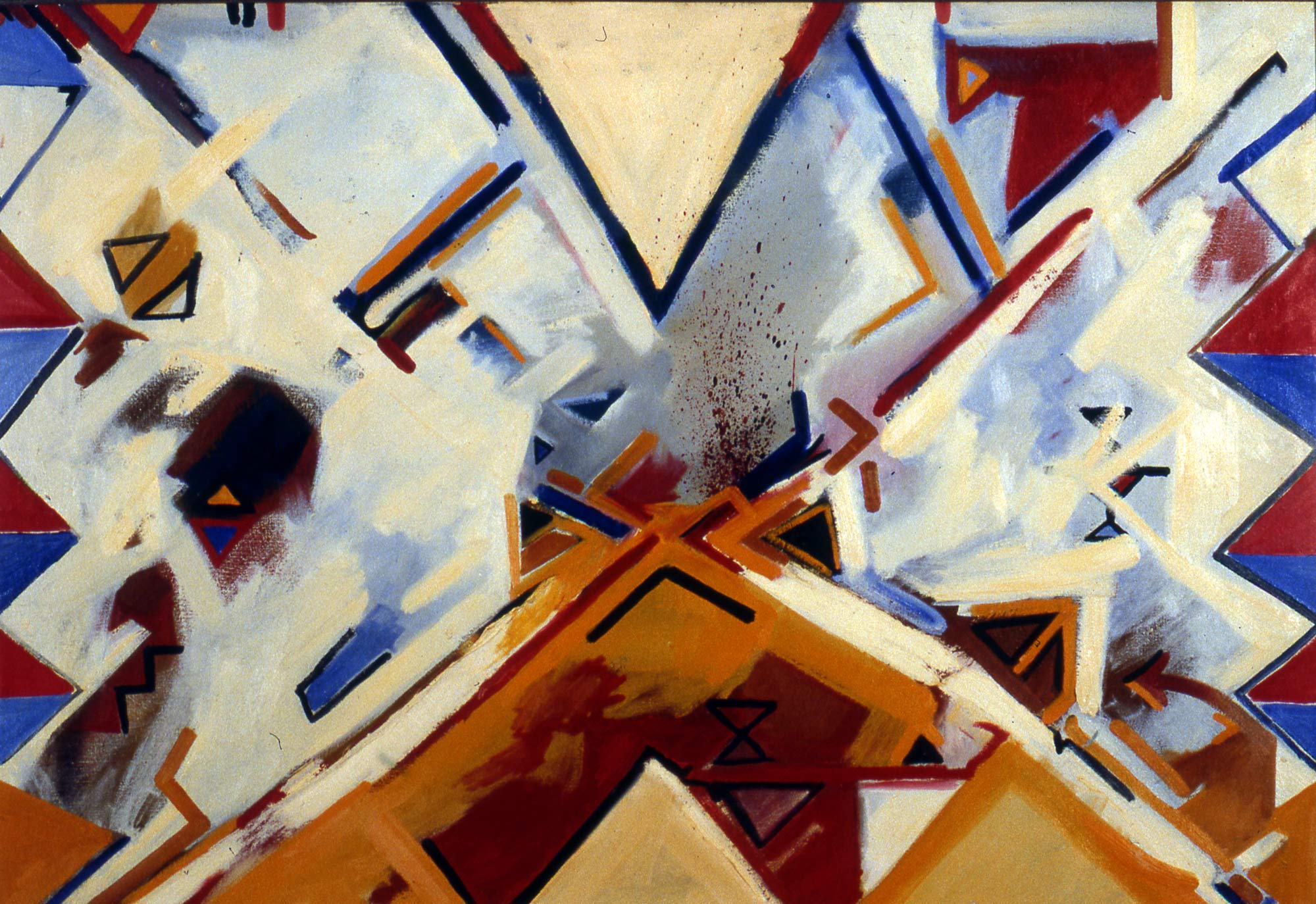
Bob Boyer, Parfleche; Handle with Care, 1980
Oil on canvas, 97.5 x 135.5 cm
SK Arts Permanent Collection, Regina
As an artist, educator, and curator, Métis painter Bob Boyer played a key role in the resurgence of contemporary Indigenous art in Regina and throughout Canada. Boyer was one of the first artists to fully integrate Indigenous world views and cultural commentary into modern painting, producing work that challenged colonial narratives and transformed traditional forms into powerful political statements addressing issues such as colonization, racism, and cultural survival. Best known for his bold and geometric works such as Parfleche; Handle with Care, Boyer blended his culture’s traditions with modern abstraction, cultivating a unique style that brought indigeneity into mainstream conversations about contemporary art in Canada.
-
Bob Boyer, Rawhide on Canvas, 1981
Oil on canvas, 142 x 168 cm
First Nations University of Canada, Regina
-
Bob Boyer, A Smallpox Issue, 1983
Oil with rawhide on blanket, 190 x 122 cm
SK Arts Permanent Collection, Regina
-
Bob Boyer, Let the Acid Queen Rain: The White Goop Devours All, 1985
Oil and acrylic on blanket, 185 x 127 cm
Canada Council Art Bank, Ottawa
Born in Prince Albert, Saskatchewan, Boyer studied with Regina Five member Ted Godwin (1933–2013) at the University of Saskatchewan, Regina Campus, earning a bachelor of education (art) in 1971. He had already begun his artistic career in the late 1960s, painting highly representational landscapes and portraits before shifting his focus to semi-abstract depictions of Indigenous ceremonial and everyday objects in works like Sun Dance Shield, 1980, and Rawhide on Canvas, 1981. With these, he incorporated design elements of traditional hide painting and beadwork, combining them with the painterly abstract expressionist techniques popularized by the teachers and students at the Regina Campus.
Between 1983 and 1995, increasingly concerned with the situation of Indigenous people in Canada, Boyer produced a series of paintings on flannel blankets. These “blanket statements” merged geometric elements of historical Northern Plains design with personal symbolism and contemporary references. Starting with A Smallpox Issue in 1983, Boyer alluded to the distribution of blankets infected with smallpox to Indigenous populations. Among Boyer’s best-known blanket works are A Minor Sport in Canada, 1985; Trains-N-Boats-N-Plains: The Nina, the Santa Maria and a Pinto, 1991, a triptych of three painted blankets; and Happy Columbus Day, Carney, 1992, all of which explicitly critique the devastating impact of Canada’s colonial past. Let the Acid Queen Rain: The White Goop Devours All, 1985, conveys a more specific environmental message, calling attention to the impact of acid rain in destroying Earth’s protective blanket.
Guided by the belief that Indigenous art should be given the same care and consideration as non-Indigenous art, Boyer was an influential teacher at the Saskatchewan Indian Federated College (now First Nations University of Canada) as well as a renowned curator. His curatorial achievements include several exhibitions at the MacKenzie Art Gallery, notably 100 Years of Saskatchewan Indian Art, 1975; Kiskayetum: Allen Sapp, a Retrospective, 1994; and The Powwow: An Art History, 2000.
Boyer died after suffering a heart attack while attending a powwow in Nebraska. His groundbreaking career was celebrated with a travelling exhibition organized in 2008 by the MacKenzie in collaboration with the Canadian Museum of Civilization (now the Canadian Museum of History) and curated by Lee-Ann Martin: Bob Boyer: His Life’s Work.
 About the Author
 More Online Art Books
 Acknowledgements