
Oliver B. Buell (1844–1910)
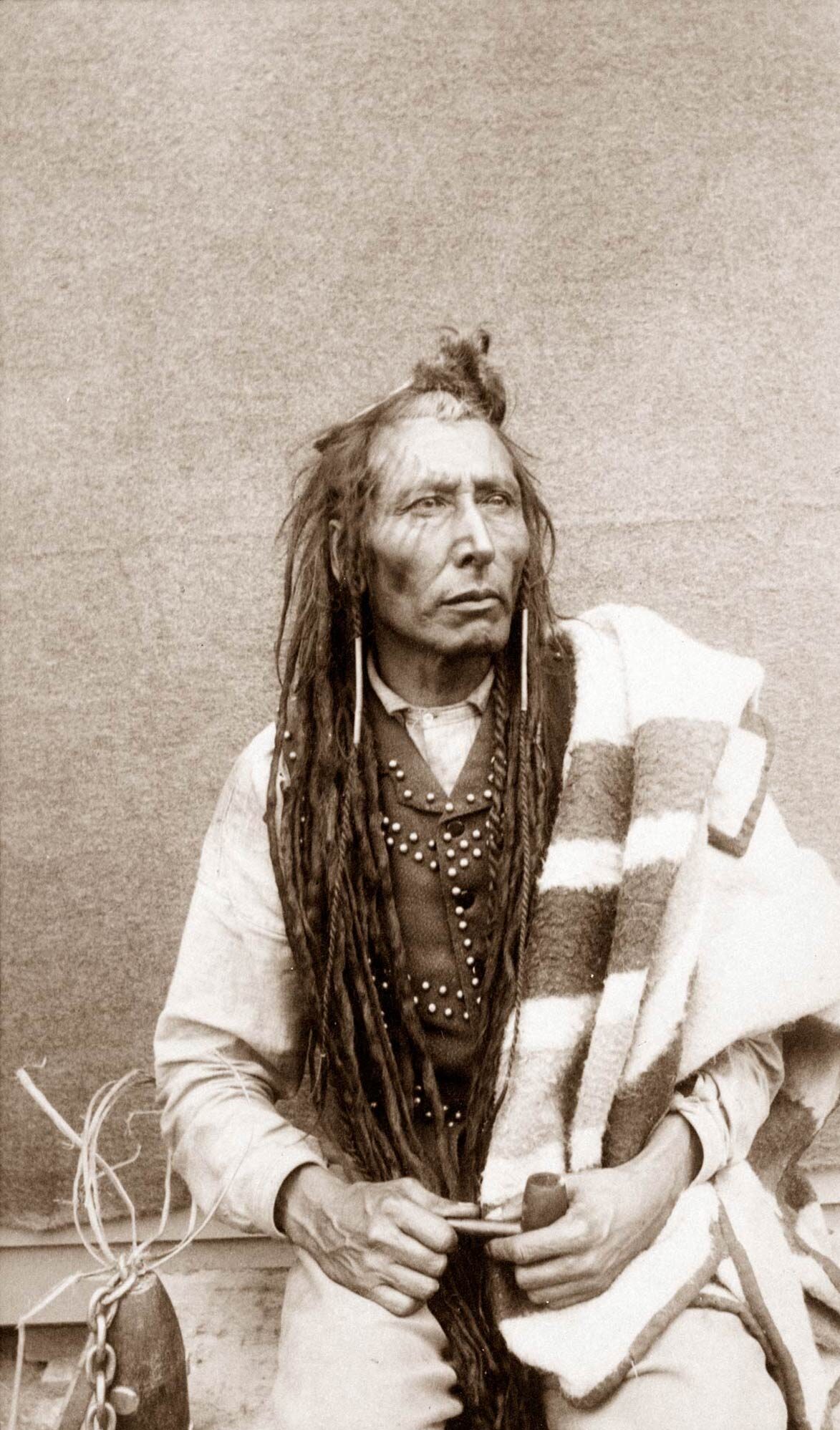
Oliver B. Buell, Poundmaker, also known as The Drummer (ca. 1842–1886), a Cree chief, later adopted by Crowfoot of the Blackfoot Nation, 1885
Photograph, 19.7 x 11.4 cm
Library and Archives Canada, Ottawa
Oliver B. Buell took his now-famous portrait of Chief Pitikwahanapiwiyin (Poundmaker) (c.1842–1886) in Regina in 1885, shortly after the chief’s arrest for his role in the Battle of Cut Knife, an armed skirmish between the North-West Mounted Police and a coalition of First Nations and Métis led by Louis Riel. The photograph shows Pitikwahanapiwiyin shackled and looking pensively into the distance. He wears a Hudson Bay blanket over his left shoulder and holds a pipe. An itinerant photographer, Buell often produced albumen prints of several of his photographs to sell as souvenirs, including this image of Pitikwahanapiwiyin. His portraits of Pitikwahanapiwiyin, Chief Mistahimaskwa (Big Bear), and others suggest that Buell was somewhat outside of his time in depicting his Indigenous sitters in a sympathetic light.
-
Oliver B. Buell, Graveyard at Fort Qu’Appelle, 1885
Black-and-white photograph, 11 x 19.4 cm (image), 12.8 x 21 cm (mount)
Library and Archives Canada, Ottawa
-
Oliver B. Buell, Troops en route, North West Rebellion, 1885
Silver salts on paper mounted on paper, albumen process, 12.7 x 17.8 cm
McCord Stewart Museum, Montreal
-
Oliver B. Buell, Locomotive on Old Ottertail Creek Bridge, 1885
Silver salts on paper mounted on paper, albumen process, 12.7 x 17.8 cm
McCord Stewart Museum, Montreal
Buell was born in Pittsfield, Massachusetts, the son of photographer Eli Wells Buell (1818–1885). After working in his father’s daguerreotype studio for several years, he earned a living presenting travelling stereopticon slide and lecture shows throughout the United States and Canada. In 1884, Buell travelled to Western Canada with his wife, Alice, to photograph scenes along the Canadian Pacific Railway (CPR). During a stop in Winnipeg, he heard about the North-West Resistance. Recognizing the potential of such a subject for his travelling shows, Buell headed west, where he spent several months in 1885 photographing troops on their way to the front. After Riel’s surrender, Buell made portraits of key leaders of the insurgency, including Pitikwahanapiwiyin, in Regina while also producing the only photographs of Riel’s trial. In the most memorable of these, Riel stands at the centre of the courtroom, addressing the jury.
During this visit, Buell also produced some of the earliest photographic views of the Qu’Appelle Valley and Regina, for which he is considered “one of the very few photographers who have managed to capture the grandeur and clarity of the prairie landscape and sky with such skill.” Among them is a photograph of an Indigenous cemetery at the town of Lebret, near Fort Qu’Appelle, set against a distant horizon. In a view of Regina from outside the city, he included Alice in the foreground to give a sense of the vastness of the prairie.
Buell’s ability to capture the sights and moods of Canada’s landscapes impressed executives at the CPR. In May 1886, Buell was commissioned to photograph stops along the transcontinental railway to British Columbia, some of which were used for advertisements. Buell’s images captured on the route compare favourably with similar views taken by Montreal photographers Alexander Henderson (1831–1913) and William Notman (1826–1891). After a career travelling throughout Western Canada, Buell spent his last years in Montreal, where he died in 1910. His photographs are included in the collections of the Glenbow Museum in Calgary, Library and Archives Canada in Ottawa, and the McCord Stewart Museum in Montreal.
 About the Author
 More Online Art Books
 Acknowledgements