
Edward Poitras (b.1953)
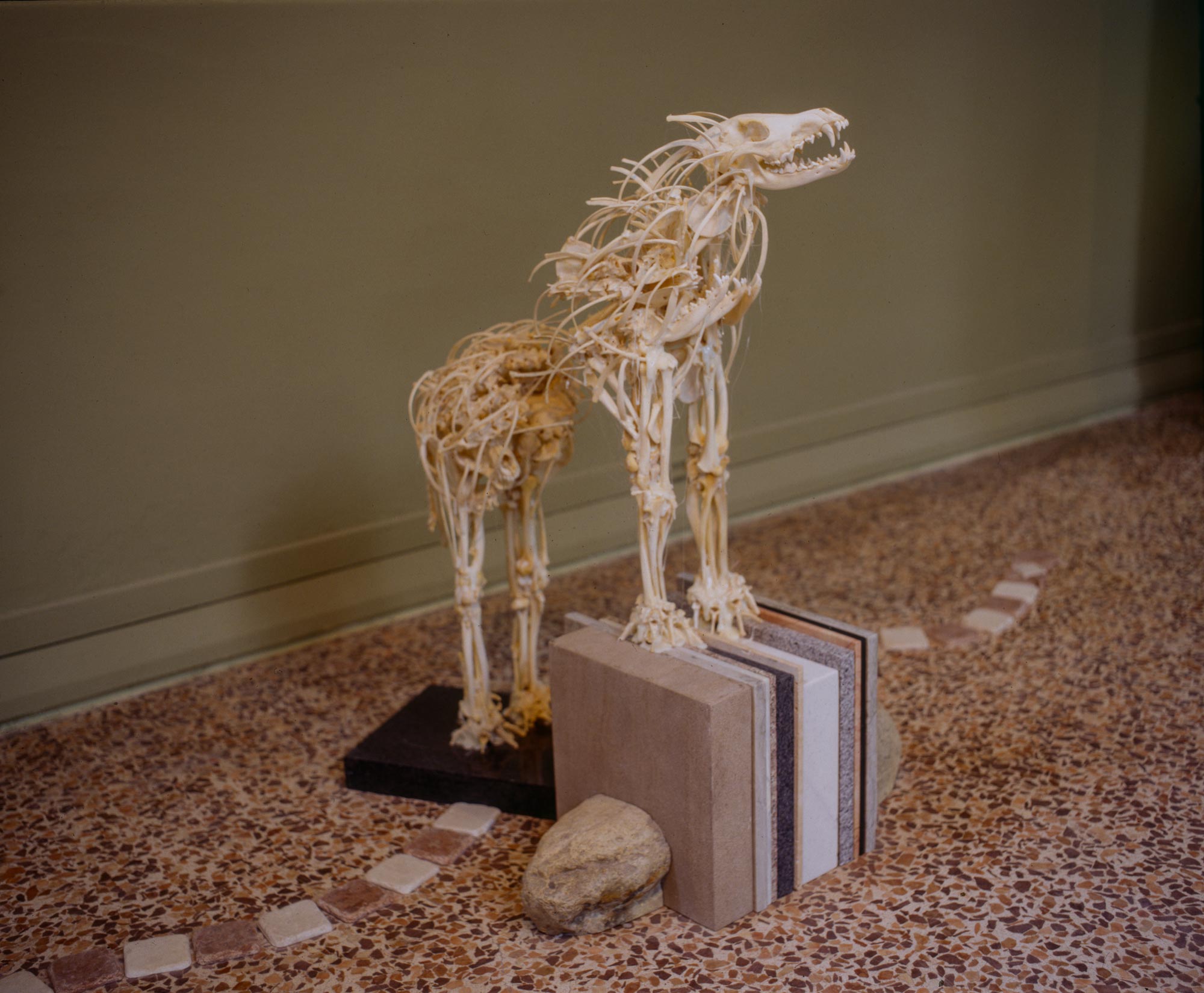
Installation view of Edward Poitras: The Trickster in the Canadian Pavilion at the Venice Biennale, 1995
Photograph by Edward Poitras
In 1995, Edward Poitras became the first Indigenous artist to represent Canada at the Venice Biennale, one of the world’s most prestigious showcases of contemporary art. Poitras produced a site-specific installation that included a roughly life-sized coyote constructed from bone fragments of various animals found on the Saskatchewan prairie. A recurrent element in Poitras’s work, the coyote represents the trickster figure in many stories among Indigenous cultures. As described by the curator of the exhibition, Gerald McMaster (b.1955), in the context of the Venice Biennale, the coyote was “a symbol of defiant survival in the face of the tragic effects of colonial imperatives.”
One of Canada’s leading multidisciplinary artists, Poitras often combines sculpture, video, performance, and found materials in his works to tell complex stories about Indigenous experiences. Merging symbolic materials such as feathers, rawhide, or bones with modern objects like barbed wire, electronics, or concrete, Poitras’s installations, such as Over the Gulf, 1989, and Black Horse Offering, 1990, produce powerful visual metaphors addressing colonial violence, treaty relations, and the displacement and cultural endurance of Indigenous Peoples.
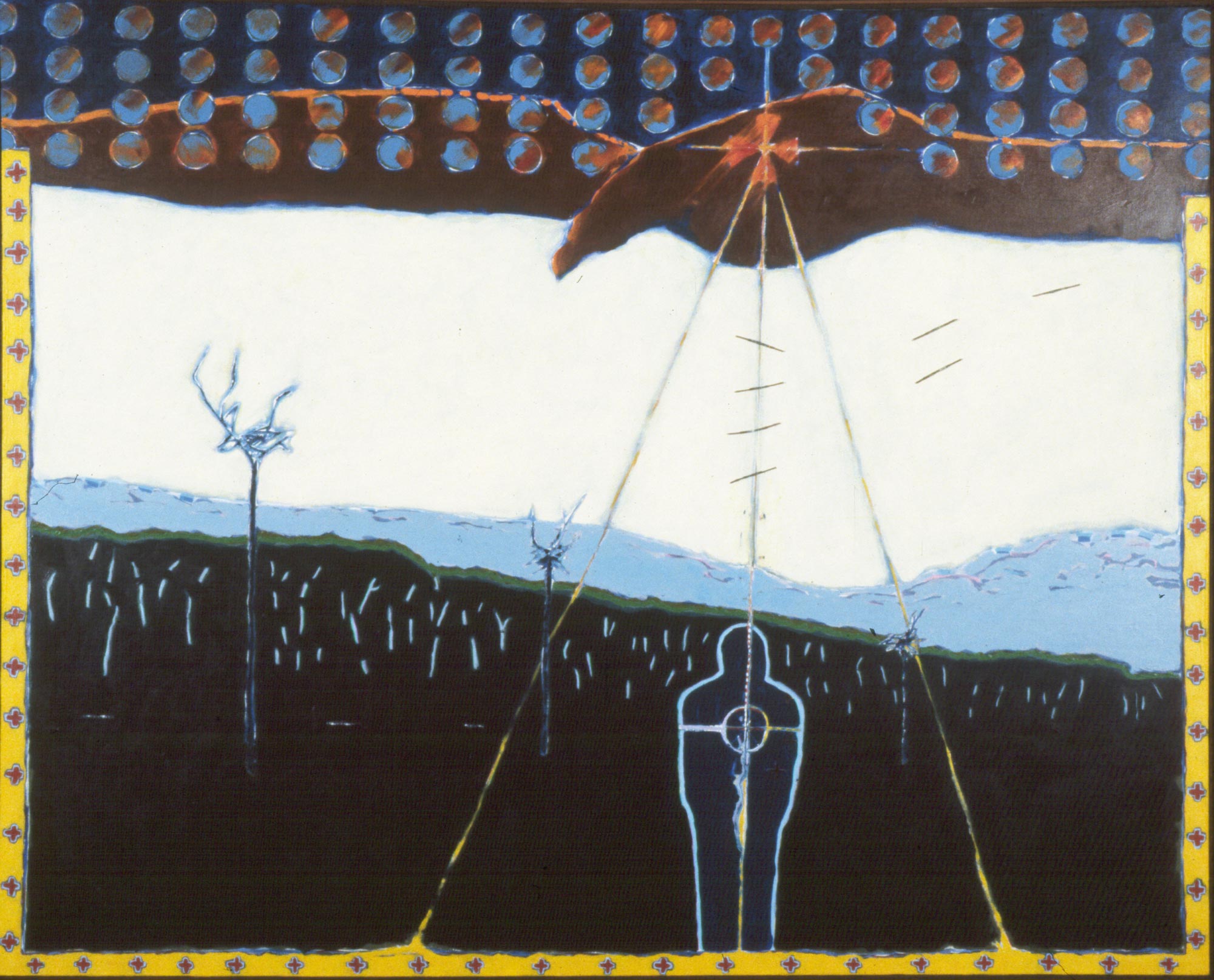
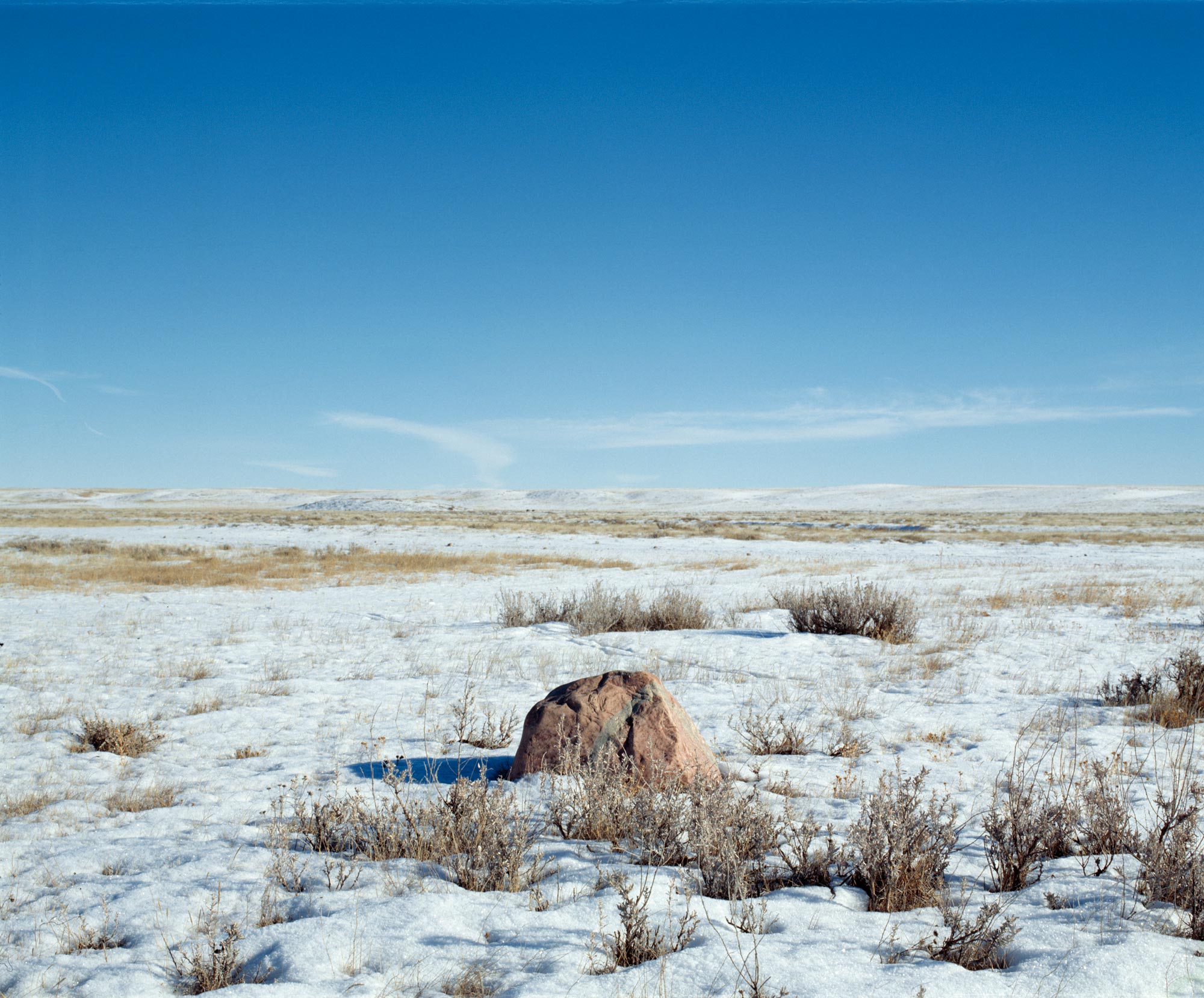
Poitras was born in Regina and is a Métis member of Gordon First Nation. He first received instruction in art in 1974 at the Saskatchewan Indian Cultural College in Saskatoon, where he was mentored by artist and poet Sarain Stump (1945–1974). Stressing the importance of Indigenous self-confidence rooted in cultural and spiritual traditions, Stump incorporated land-based lessons into his curriculum, having students camp in teepees at Moose Woods Reserve and gather natural materials like bone, wood, and stone. Stump would also invite guest craftspeople to teach students how to use these materials as transformative objects for self-expression. Poitras’s approach to incorporating natural materials into his work derives largely from his early art education.
Following Stump’s tragic death in late 1974, Poitras enrolled at Manitou College in La Macaza, Quebec, where he studied with Mexican Indigenous artist Domingo Cisneros (b.1942). Returning to Regina in 1976, Poitras began producing a broad range of mixed media sculptures and installations that explored the marginalization and suppression of Indigenous history. Five of his works, including Rainbow, 1981, and Dusty Stars, 1982, were featured in the landmark group exhibition New Work by a New Generation at the Norman MacKenzie Art Gallery in 1982.
It was during the early 1980s that Poitras began combining natural materials with circuit boards, plastic items, and other objects in installation pieces such as Day Break Sentinel, 1983, a work that also reflects his interest in the suspended figure. Poitras’s suspended-figure works culminated in his installation Internal Recall, 1986–88, in which seven life-sized figures kneel with their hands bound with rope attached to the ceiling. On a nearby wall are texts associated with treaties signed by Indigenous Peoples, which, in combination with the figures, suggest binding contracts and broken promises. In 1986, Poitras made his first work from coyote bones and glue in Coyote, a recurring motif in several later installations.
Poitras’s important contribution to contemporary art was acknowledged in 2002, when he was awarded the Governor General’s Award in Visual and Media Arts. Since then, his work has been widely exhibited, including in 13 Coyotes at the MacKenzie Art Gallery in 2012, and Revolution in a Rock Garden, a survey exhibition of work produced over four decades, at the Moose Museum & Art Gallery in 2023. Poitras continues to live and work on the George Gordon First Nation.
 About the Author
 More Online Art Books
 Acknowledgements