
Haymarket Square / Victoria Square, 1861
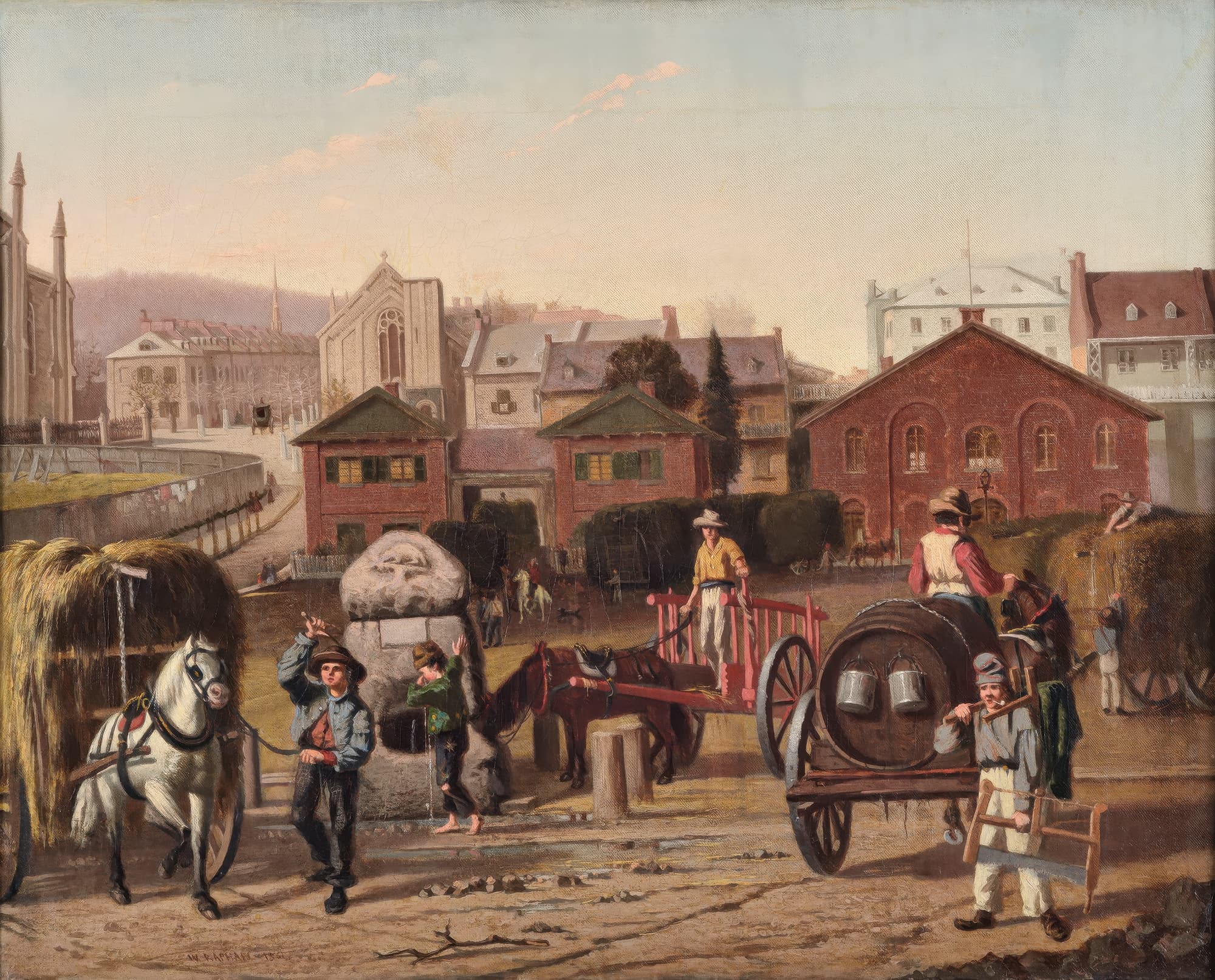
William Raphael, Haymarket Square / Victoria Square, 1861
Oil on canvas, 51.1 x 63.5 cm
Collection of Jonathan Wener, Montreal
Painted at the beginning of William Raphael’s career, this work is an example of his talent for depicting nineteenth-century urban life. With this piece, Raphael showcases his ability to create a genre scene that takes up the principles of the Biedermeier movement, which favoured realistic portrayals of everyday life. Here, he captures the bustle of the Montreal haymarket in Victoria Square.
The square was named in honour of Queen Victoria (1819–1901) following the October 1860 royal visit of her son, the future Edward VII (1841–1910). This trading space was an essential part of the city and provided a connection to the surrounding farms and lands. Locals went to the square to buy supplies for their horses and cattle, which at the time played a crucial role in transporting goods and people.
-
James Duncan, The Gavazzi Riot in Montreal, 1853
Watercolour, sepia ink, graphite, and gouache on wove paper, 32.6 x 41.3 cm
Museum of Civilization, Quebec City -
William Notman Studio, Beaver Hall Hill from Victoria Square, Montreal, QC, 1866, 1866
Silver salts on paper mounted on paper, albumen process, 8.5 x 5.6 cm
McCord Stewart Museum, Montreal
An 1866 photograph of Victoria Square produced by the William Notman Studio shows that Raphael strove for accuracy in his work. The painting is also comparable to a scene created by James Duncan (1806–1881) in 1853, the same year as a series of riots that broke out in front of the Zion Church in response to anti-Catholic speeches given by Alessandro Gavazzi, an Italian religious reformer. While Raphael and Duncan are both exacting in their depictions of the space, they frame it in very different ways: Duncan takes a more panoramic view, while Raphael invites us into the square, closer to its activity.
In the right foreground of Raphael’s painting, we see a wood sawyer and a water vendor, representing the various small trades associated with this Montreal landmark. In the centre, a barefoot child drinks from the “fountain of health,” a stone structure crowned with an image of a beaver. A harnessed horse also drinks from the fountain, while its owner stands patiently on his empty cart. To the left, a full load of hay is pulled by a white horse escorted by a man who threatens the animal with his whip. These two carts, full and empty, underline the idea of exchanges taking place in the market space. Further on, in the middle ground, several carriages are grouped together. One of the carts, heavily laden, passes through the central opening of a symmetrical red-brick building. This is a weighing building, constructed in 1842; it’s essential for determining the weight and value of any hay load.
Raphael also offers, in great detail, a precise view of the buildings that surrounded the square at the time. To the far left, part of the facade of St. Andrew’s, a Presbyterian church destroyed by fire in 1869, is visible. More centrally, a sloping roof, its peak decorated with a cross, can be seen. This is the Unitarian Church of the Messiah (destroyed by fire in 1987), whose front face is marked by arched stained-glass windows. On the right-hand side of the composition, recognizable by its grey roof and dormer windows, is the Hospice Sainte-Brigide (demolished in 1900), a shelter for the sick, the destitute, and the homeless.
 About the Author
 More Online Art Books
 Acknowledgements