
The Micmac Indian Craftsmen (MIC) became a national phenomenon, transforming Indigenous storytelling through modern design. Featured in major exhibitions and school textbooks, their work reached hundreds of thousands and was hailed in newspapers nationwide as both innovative and culturally vital. The MIC fused narrative, artistry, and entrepreneurship in ways never before seen. Their popularity and influence marked a watershed moment in Canada, bringing Indigenous voices and stories into the national imagination.
Optimism in the MIC Workshop
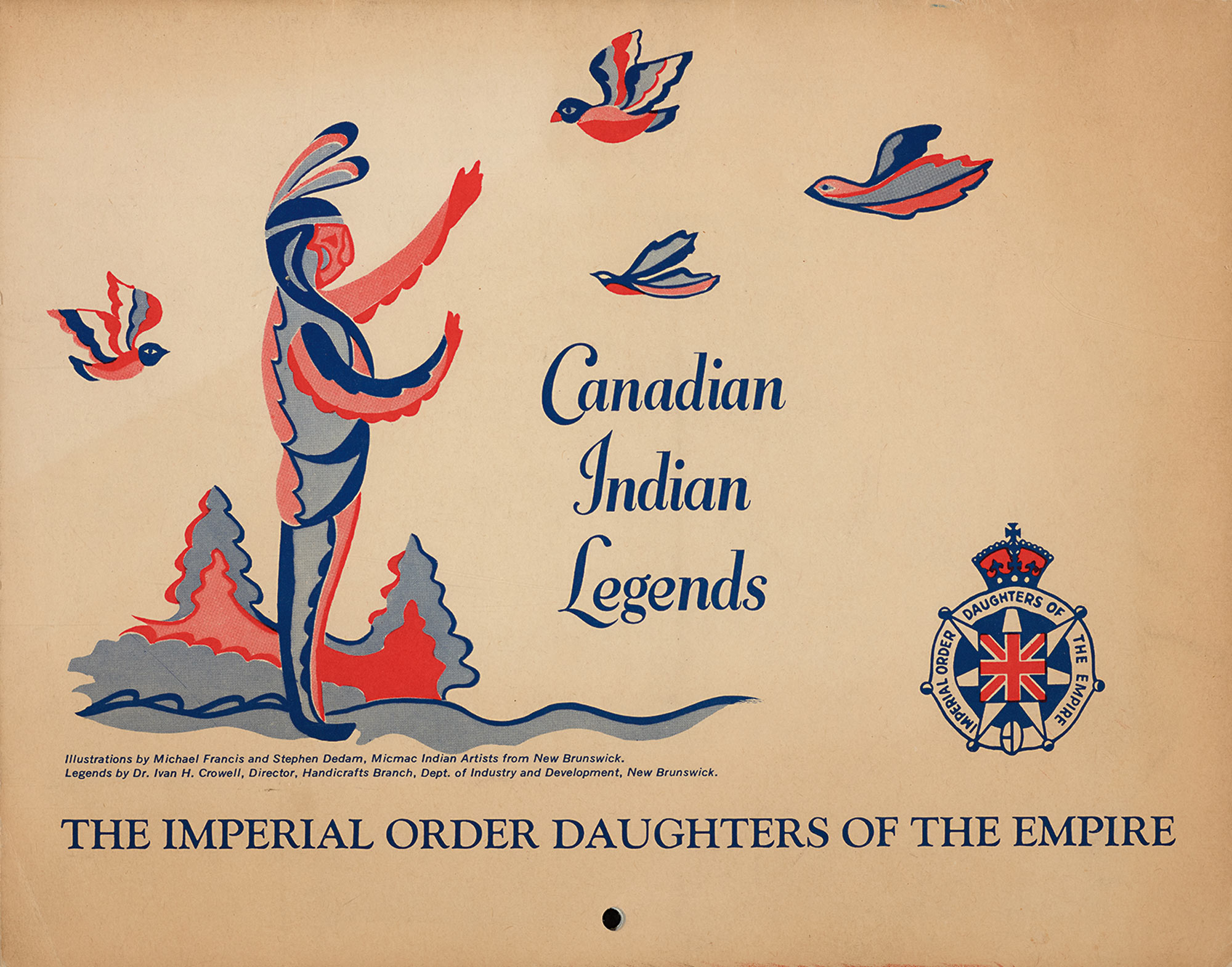
After the 1962 gift show, the MIC saw a wave of interest coming and ordered 70,000 blank Hasti-Note cards in anticipation. This sudden interest in Indigenous artistic content prompted Ivan H. Crowell to contact the national office of the Imperial Order Daughters of the Empire (IODE). They decided that the MIC artists would illustrate their nationally distributed calendar, which had annual orders in the tens of thousands and frequently ended up in schools.
Crowell and his staff’s understanding of the MIC’s potential is evident in his early correspondence and meeting records. So too is his consideration of how important it was to have the people of Big Cove design and make the pieces themselves. He felt his role should be geared toward teaching technique, not influencing their personal artistic styles. While Crowell knew revenue was important, creating a true collaborative studio was equally so. Craftsman Vincent Barlow recalls: “Eva and I and Stephen and all, we always helped each other. If I ran against a problem, I said, ‘Steve, how do we do it this?’ And he would show me, ‘Okay, good.’ That’s how we did it. And then, if anybody asks me anything that I have any knowledge towards, I’d help them out as well.”
Even with the positive maker environment, there were growing pains where business and technical skills were involved. Some government officials expressed frustrations with what they saw as the group’s educational and practical limitations, a contemptuous tone of “us” and “them” creeping into their words:
We have, undoubtedly, considerable talent on this reserve, but most of them have not gone beyond grades 5 or 6 and never received one hour of instruction in such things as color appreciation, balance, tones, and whatever else a designer’s work should reflect. This is a career of hard, painstaking work and even those with talent must learn to do “finished” work.
These issues notwithstanding, optimism was taking hold. The MIC opened a bank account and purchased raw materials. Orders started pouring in. F.B. McKinnon wrote that “if a grant of $7,000 is instrumental in training and developing 20 to 30 people and initiating a project that could become worthwhile, I believe it should be considered a good investment.”
The progressive qualities of the new MIC work were not lost on Crowell, “… the Indians are particularly anxious to make the most modern products using the most modern methods,” he noted. By February 1963, government officials worried about bootleg or foreign imitations of the MIC’s popular graphic designs began looking into how to secure patents and other forms of intellectual property protection to safeguard them.
Artists at the Centre
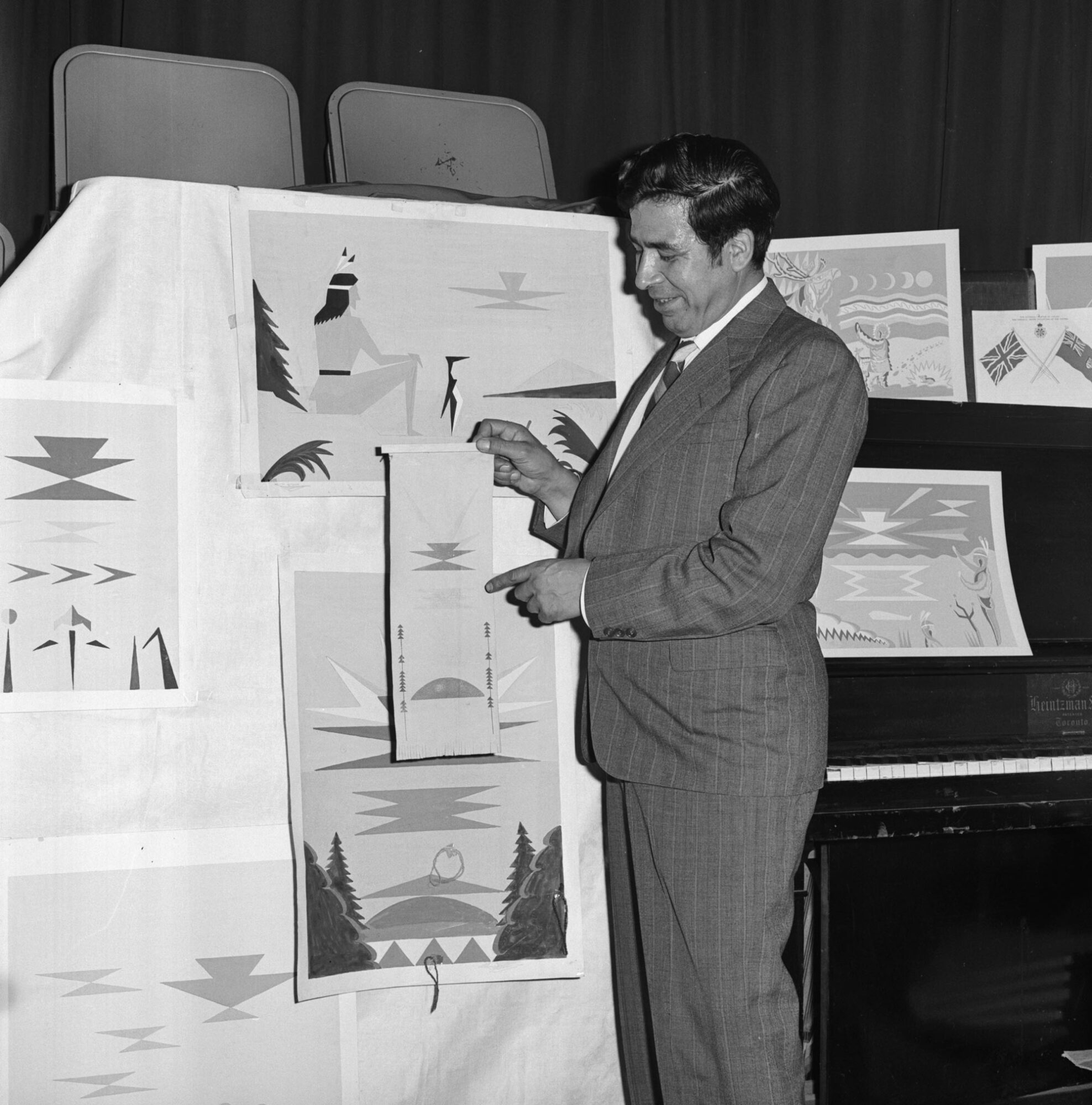
A decisive hire took place at the onset of 1963. Michael Francis was back home visiting his sister Sarah at Big Cove that January. After a meeting with Crowell, he was brought into the fold for two weeks. He was supposed to go back to Maine for a trucking job, but he never did, and his arrival would be transformational. Crowell immediately recognized that Francis was “a highly gifted artist and designer.” The MIC had not only found their main designer and creative hand, but their greatest public ambassador. Vincent Barlow called him “one of the finest artists that I’ve ever seen.” Francis was also a talented storyteller and musician; he was even hired to provide translation from English to Mi’kmaw for a Walt Disney movie. It was for the 1965 feature film Those Calloways, a live-action drama that had a Mi’kmaw speaking character—played by an Italian American, which was awkwardly typical for the era.
In a letter sent to the Chief of the Indian Affairs’ Economic Development Division in Ottawa, F.B. McKinnon was excited about the conversion of Big Cove’s old one-room schoolhouse into the MIC studio workshop, but his big focus was on Francis’s arrival. He predicted that pairing him with Stephen Dedam would produce great results:
[Francis] is a talented type, full of old Indian legends and has considerable artistic ability. He was referred to Dr. Crowell and he is now in Fredericton studying and working on Indian designs originating from the old stories. Any design used on the cards he will be paid at the rate of $5.00 each. When the design is enlarged and used for tapestries he will be paid $35… Proceeding simultaneously with designs for cards and tapestries are designs for jewellery and pottery from the same general theme. These will be made on the Big Cove reserve by Steve Dedam if, of course, they are in demand.
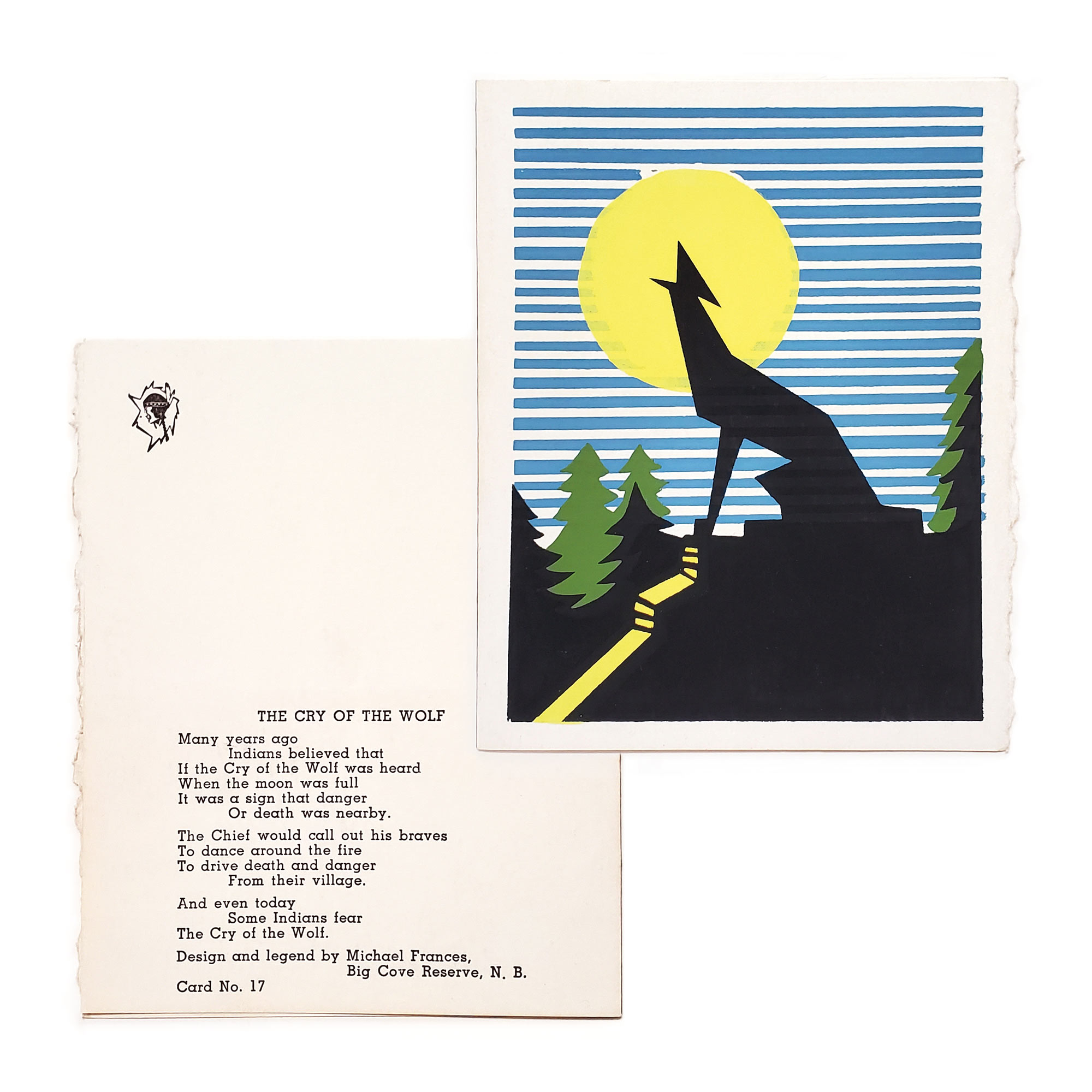
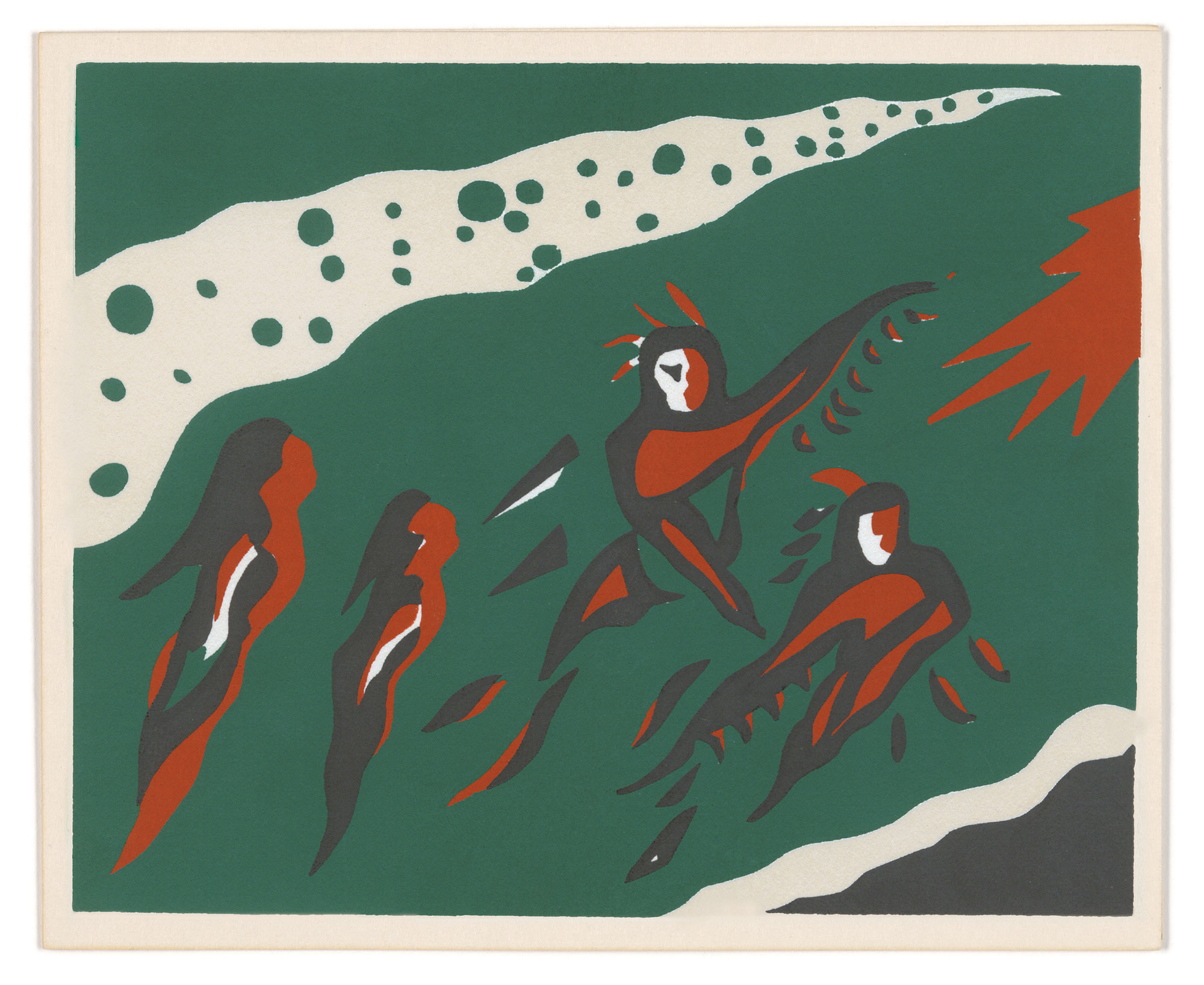
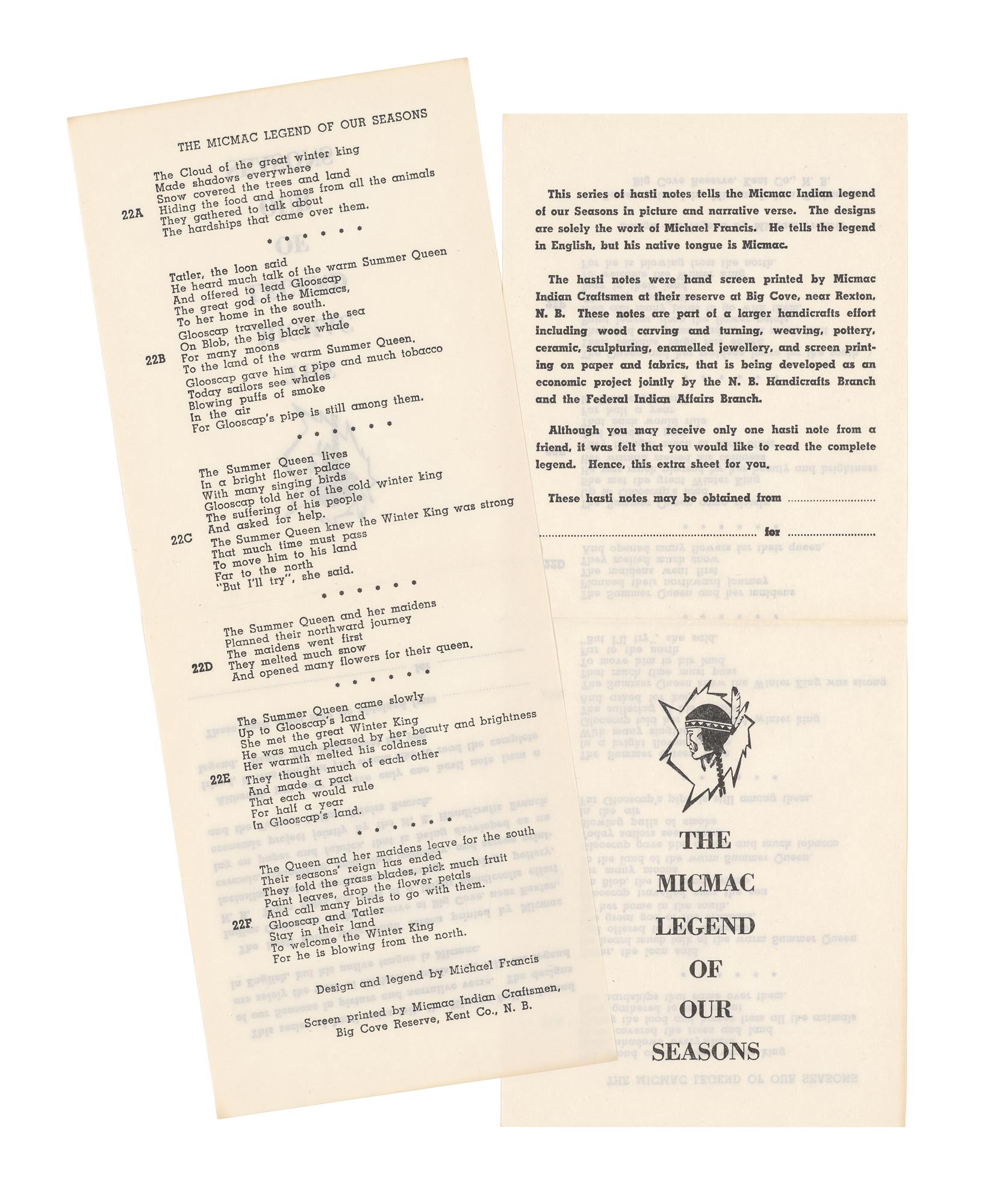
The Hasti-Notes’ strong sales made them a top priority, with tapestries and wall hangings next in line. Michael Francis was put in charge of their design, as well as writing the legends/stories from Mi’kmaw Oral History. The first one from his hand was The Cry of the Wolf, a bold silhouette of a howling wolf at night. His effect was immediately felt. His new Hasti-Note designs, the ink hardly dry, sold 31,032 cards at the Toronto gift show in February 1963. This order was based for the first quarter of the year only, which implied sales of 120,000 cards annually, far more than Crowell anticipated. The studio bumped their supply orders overnight, from small tins of ink to ten-gallon drums. Card orders were increased to lots of 48,000 blanks at a time. By the end of the 1962–63 government fiscal year, the MIC had sold an astounding 176,000 silkscreened Hasti-Note cards across North America.
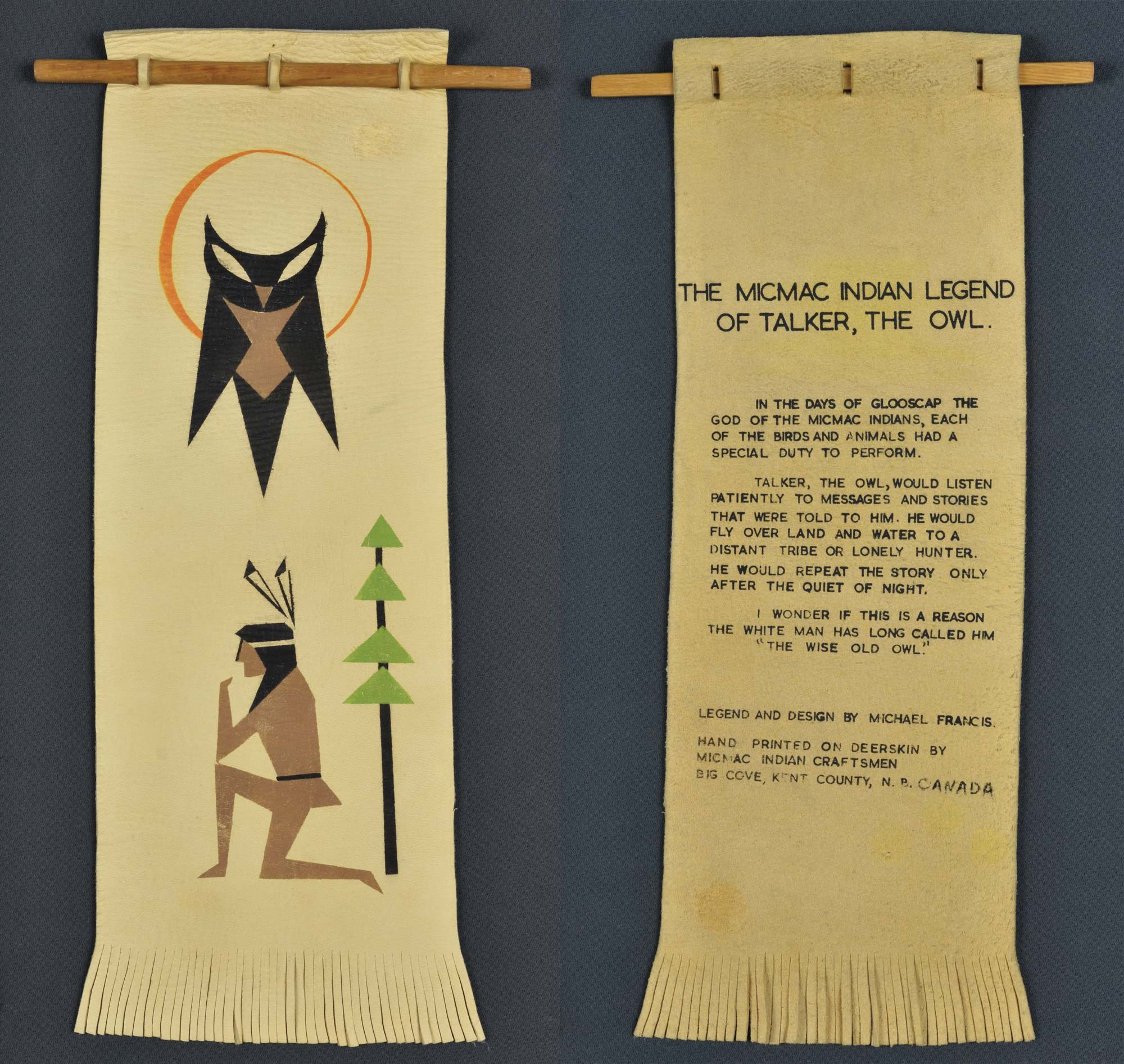
- They also explored etched glass, tapestries, weaving, clay figures, metalwork, wall hangings, custom patterned English porcelain, and even a handwoven “Micmac tartan.” By embracing modern designs in a semi-industrial model of production, magic was happening in the community. Working in the old schoolhouse that had been transformed into a shared studio and workshop in April 1963, dozens of Mi’kmaw men and women produced some of the most inventive and commercially successful visual art, design, and fine craft ever made in eastern Canada.
Design and Innovation at Big Cove
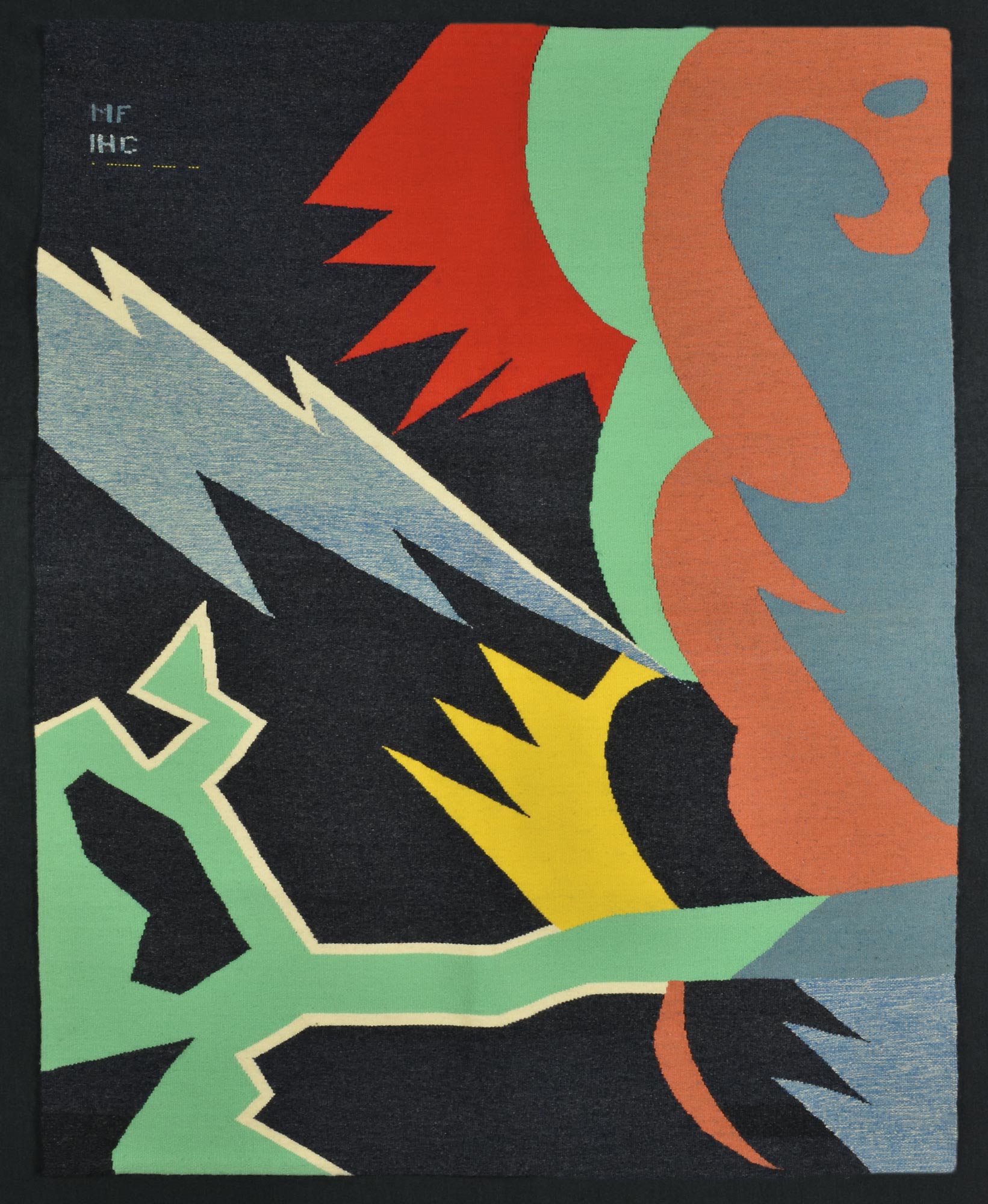
Crowell was so keen on the industrial potential of their weaving and fabric design that he approached the Primary Textile Institute of Canada and two large fabric printing businesses in Montreal, as well as the federal department of Trade and Commerce for their buy-in. Discussions began with the principal of the New Brunswick Teachers’ College, which was in the midst of building large facilities on the UNB campus in Fredericton. They were interested in MIC tapestries based on local Indigenous legends to hang throughout the buildings.
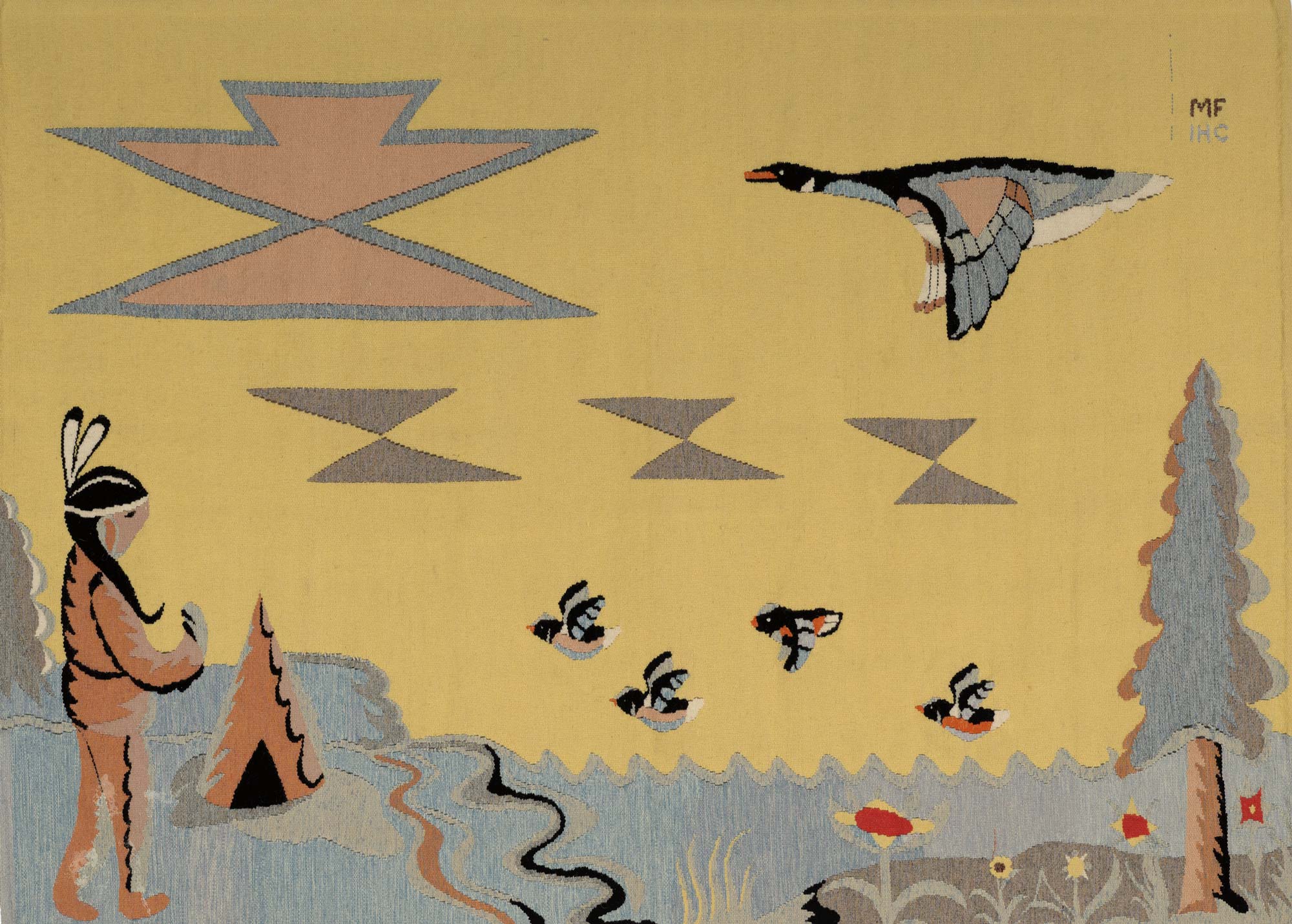
With this emerging visibility, a new studio and home base could not arrive soon enough. Opened in April 1963, the repurposed old Big Cove schoolhouse had a wing that doubled the original footprint, giving ample space to welcome tourists and offer the now sixteen employees room to work. However, even as the MIC operation was becoming more established and orders poured in, some work disruptions began to be felt. On May 1, 1963, McKinnon wrote to the Indian Affairs Branch about artists leaving the handicraft studio to “cut potato seed in Maine,” take other jobs, or simply not show up for work. There were also difficulties around meeting deadlines and working set hours. McKinnon pointed out that “handicraft (as we were doing it) did not pay as much as labor in the U.S.” The training and makeup of a roster of artists, along with the division of labour, were also becoming issues, although not as pressing as how to keep up with demand.
Crowell put one hundred packs of Hasti-Notes at a Fredericton outlet, and they sold out in two days. With standing orders for fifty thousand cards (many in small lots for individual shops), the MIC began refusing to take repeat orders. They simply did not have the manpower to fulfill demand. Orders were piling up, and the lack of capital was becoming a serious challenge to order materials and pay the artists regularly. The recurring payback amounts on the federal loan were steep, affording the MIC little room to get their financial legs under them. At this point, McKinnon requested an additional loan from Indian Affairs for six or seven thousand dollars to remedy the situation, telling them “it will be money well spent.”
-
Michael Francis, Micmac Indian Legends of the Little People, Series 1B, 1963
Silkscreened Hasti-Note card, 10 x 13 cm
Private collection
-
Michael Francis, Micmac Indian Legends of the Little People, Series 1D, 1963
Silkscreened Hasti-Note card, 10 x 13 cm
Private collection
-
Michael Francis, Micmac Indian Legends of the Little People, Series 1F, 1963
Silkscreened Hasti-Note card, 10 x 13 cm
Private collection
The MIC studio was a beehive of activity by early summer 1963 and the workers were asking for more space to allow for greater production. The sky seemed to be the limit for the Hasti-Note cards, which now featured fully integral Indigenous designs and texts. One of their most graphically inventive was The Legend of the Tidal Bore. On an aqua background highlighted by white bubbles and stylized water plants, a green lobster battles a black eel to return it to the Petitcodiac River, an event that created the famous tidal bore. The design was by Francis, but it has a spare compositional sophistication and dynamism that reminds one of the cut-outs of French artist Henri Matisse.
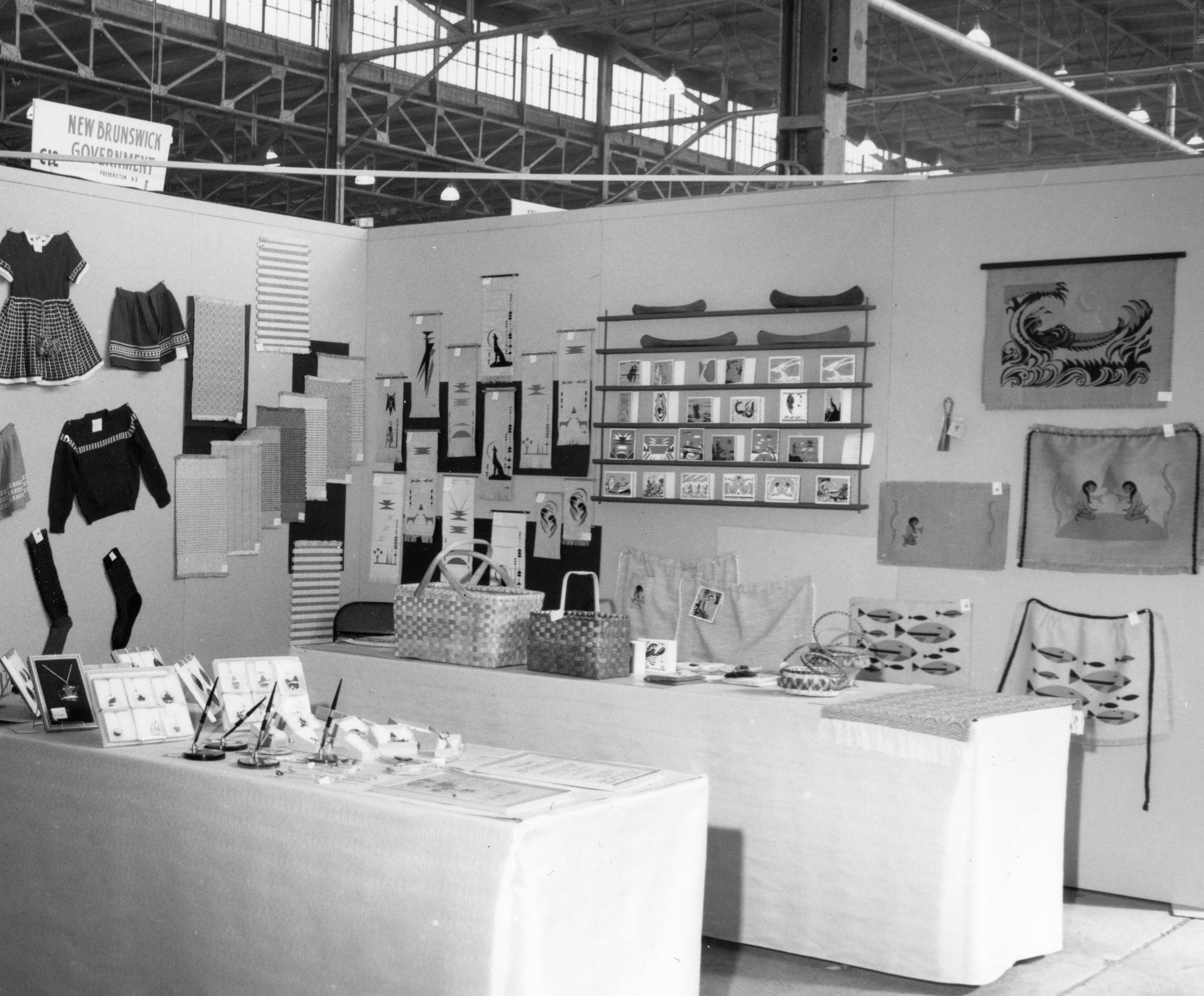
In his third quarterly report to the Indian Affairs Branch, Crowell remarked the silkscreened cards were flying off the racks so fast that they had to shut down the profitable pottery studio to make more room for the printers. Demand was also growing for their woven placemats, car robes, neckties, and woodwork pieces. The studio was now running two shifts a day, six or seven days a week. A full-time clerk was needed to manage the store and corral tourists and visitors, as “workers [were] literally mobbed by fascinated questioners” during busy days.
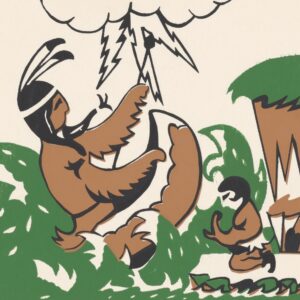
Michael Francis’s artistic style was becoming more curvilinear compared to the straight-edged approach of his earlier designs. His colour palette was also evolving into a more pastel direction and less boldly contrasting. Francis was constantly inventing new designs, and his latest series of cards featured the story of the Micmac Little People. While the final designs were by Francis, MIC studio employee Jane Dedam tells a story where the inspiration for a particular card came from one of the studio workers:
We were sitting down at my sister’s house [Eva Milliea], and we were talking about all these designs, and she starts sketching and she sketched this. Anyway, she shows it to somebody at the ‘craft’ and they said, ”Oh that’s great, would make a good card.” So they redesigned it.
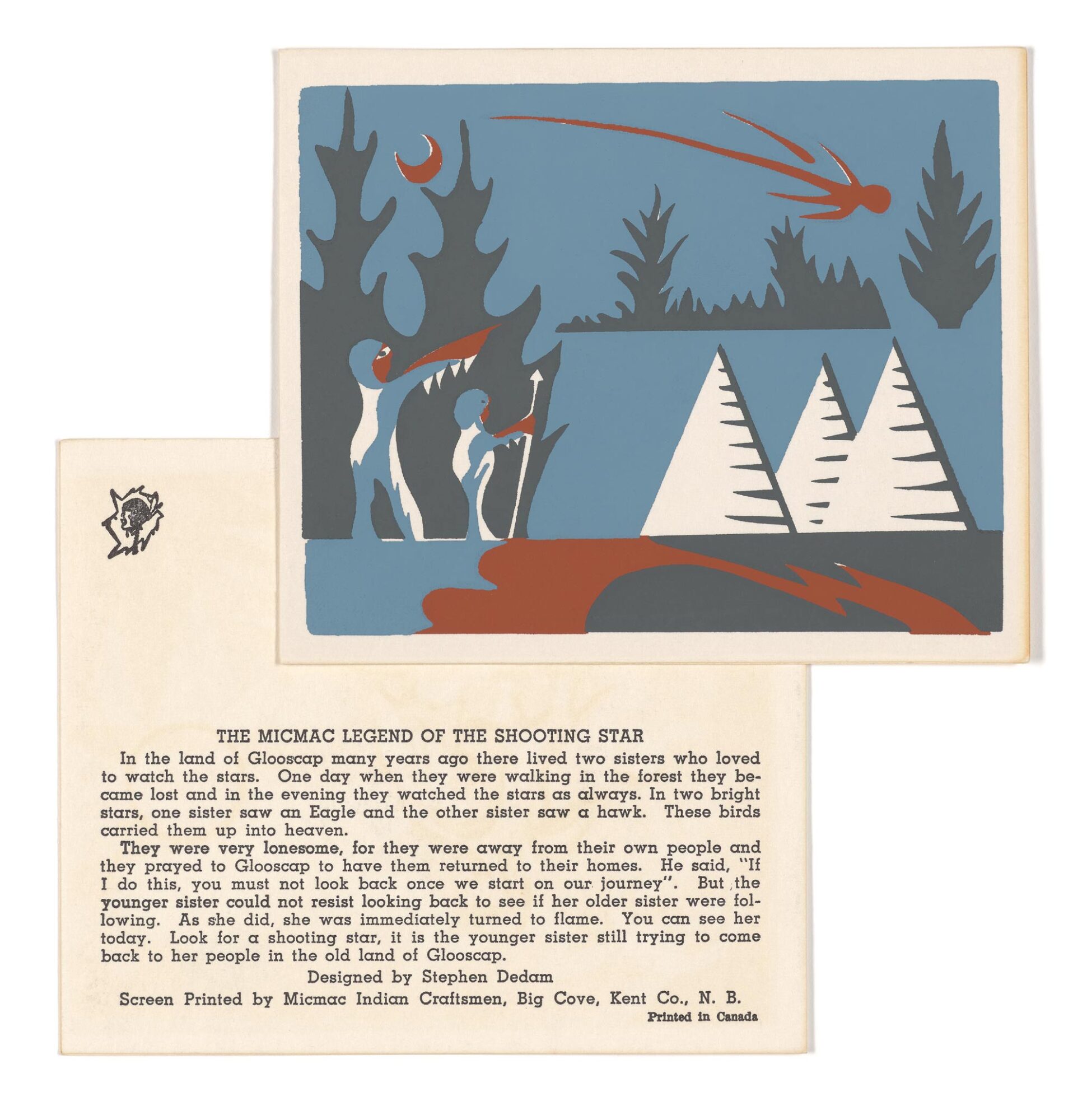
Further Hasti-Note card sets included The Micmac Indian Legend of the Wild Goose and The Micmac Indian Legend of the Turtle. Stephen Dedam designed several series as well, including The Micmac Indian Legend of the Shooting Star and A Legend of the Partridge and the Loon. The cards and collected stories may very well have influenced the emerging Norval Morrisseau, who in September 1963 announced he was releasing a set of illustrated Christmas cards and a “special book of Indian Legends.”
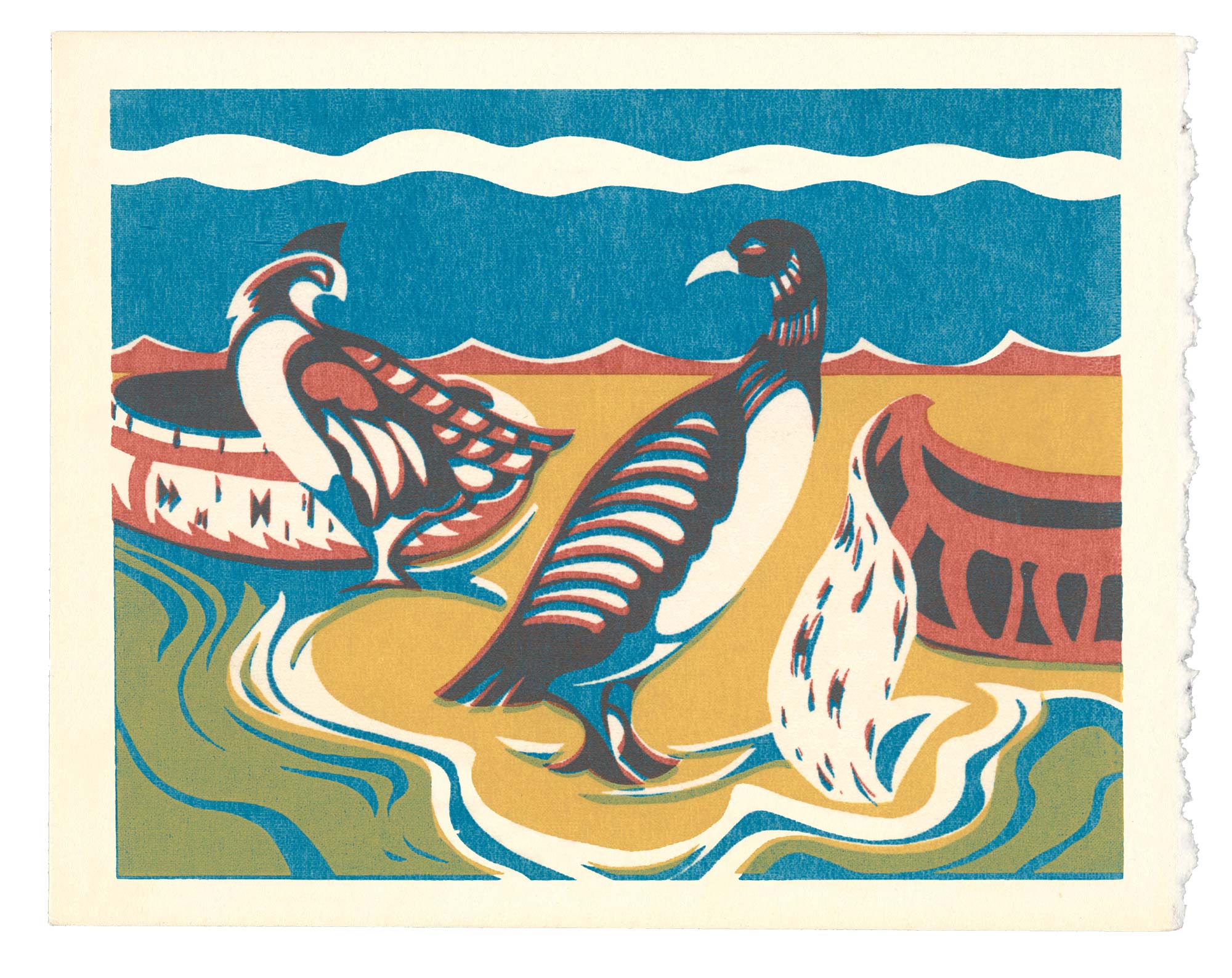
With an insight and understanding that was ahead of its time, Crowell and the MIC administrators developed piecework projects that the local mothers could do at home so they could work while looking after their young children. As an MIC member and young mother at the time, Jane Dedam remembered, “I was the one who did the burlap bags because, you know there were times I could go to work and there were times I had to work at the house with no sitter.”
A Growing Reputation
With the MIC enjoying remarkable sales numbers, after not even a year in business, it is difficult in hindsight to understand Indian Affairs’ reluctance to loosen the purse strings. The federal government did end up coming through with $8,000 to fund a second year of MIC operations, but it took effort to extract it. The entire cost of the project from September 1962 to September 1963 was $10,443.71. Even translated into today’s dollars, the loans to the Handicrafts Branch and the MIC were far from sizeable, yet their effect on the MIC and the local culture was immense. By mid-July 1963, payroll was around $1,000/month. Wages to the end of July 1963 were $3,070.17 for all the handicrafters. But as always, the future was uncertain. Around late July 1963, a handwritten note by Crowell says that “only time will tell whether [the] operation can sustain itself.”
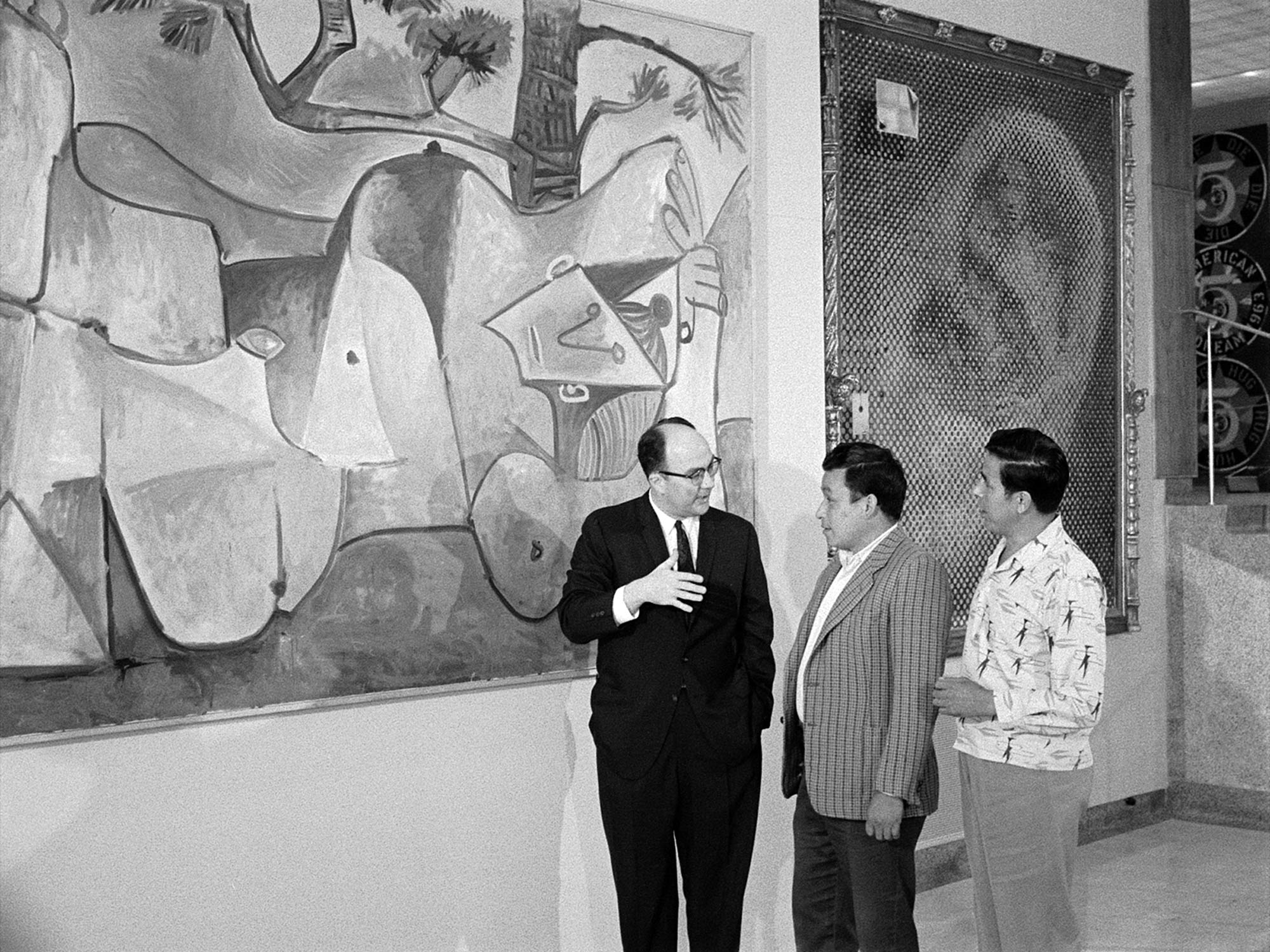
Media features about the Mi’kmaw artists started to appear from coast to coast, and the MIC became one of eastern Canada’s major cultural bridges between Indigenous and non-Indigenous society. The National Film Board filmed Michael Francis and MIC co-worker Gilbert Augustine in front of a Picasso painting at Fredericton’s Beaverbrook Art Gallery during the pivotal Dunn International art exhibition in late 1963. The Indian News, a nationally circulated monthly, printed an illustrated article showing Francis working on an original painting in his Fredericton studio under the title “Talented Micmac Artist.” Articles on the MIC like “Handicraft Revolution Brings Prosperity to Micmac Indians” in the Victoria Times Colonist, “New Way of Life for Micmacs via Business” in the Saskatoon Star-Phoenix, and “Legends Become Handmade $$$ for Micmac Band” in the Toronto-based Financial Post were becoming commonplace.
The Financial Post piece was illustrated with the charmingly sophisticated silkscreen graphic of the Little People around a canoe as well as a closeup photo of Michael Francis holding a large glass vase with a goose he etched, its design based on an ancient Mi’kmaw story. The image and object show the wide reach and exploration that made Francis seem worthy of the photo’s caption: “How Micmac artist Francis sparked Big Cove success.” “Gone,” the article concluded, “are the days of earning a few dollars from souvenir birchbark canoes and teepees.”
Strain Amid Success
In early June 1964, a pair of federal bureaucrats from Ottawa visited the MIC operation out of concern for the project’s ability to maintain its progress and its financial health. They questioned if “branch expenditures were justified in relation to the benefits being obtained by the Indian participants.” The MIC was earning more, but they were never quite able to get their head above water due largely to the tight demands of the federal loan repayments.
Although the MIC’s value was framed as providing desperately needed employment and wages, creating a situation where “families are earning sufficient income to reduce their reliance on assistance from welfare,” some MIC employees did not get paid regularly. This understandably affected worker morale and their allegiance to schedules. Vincent Barlow recalls rarely getting paid for the work he did: “I wouldn’t say I worked there, I participated. Someone was getting paid, but it wasn’t us.” Jane Dedam claims she wasn’t paid in full until several years after the operation ended. Many MIC members left for four weeks each summer, as they could make more money working in the agricultural fields of Maine. This was understandable as Big Cove had among the lowest average annual earnings per worker of any First Nations reserve in Canada during the mid-1960s ($734).
By mid-1964, problems with the MIC’s management retail operations, and cashflow, among other issues, were becoming evident. The local Indian Affairs office in Chatham took the MIC’s bank accounts and financial operations, completely out of local hands. Ottawa still agreed to provide a further year’s financial support (along with the Province of New Brunswick), stating, “Big Cove has proven to be a worthwhile undertaking”; however, the federal department made it clear that the project had to be “self-managed and operated on or before September, 1965” without further assistance.
-
Map of New Brunswick, n.d. Before the late 1960s, the community of Big Cove was not featured on provincial maps.
-
Map of New Brunswick, picturing the community of Big Cove, n.d.
These challenges notwithstanding, there was enthusiasm for the benefits of employment, and the MIC encouraged a significant sense of pride within the community. As a June 1964 federal report states: “Provincial road signs proudly point to the location of the operation, the press has lauded the group on frequent occasions and some of the participants have been invited to address non-Indian handicraft groups elsewhere in the Province.” The new road signs may have seemed positive, but in fact they show the utter lack of acknowledgement the community had before it became a draw for tourism. The population of Big Cove in the early 1960s was around 700, but the reserve was not identified on the province’s official road maps. This despite the fact that more than a dozen Kent County hamlets shown on these same maps had a fraction of the reserve’s population. By the late 1960s, a dot with the words Big Cove finally appeared. It is no cliché to say the public visibility and draw of the MIC literally put Big Cove on the map.
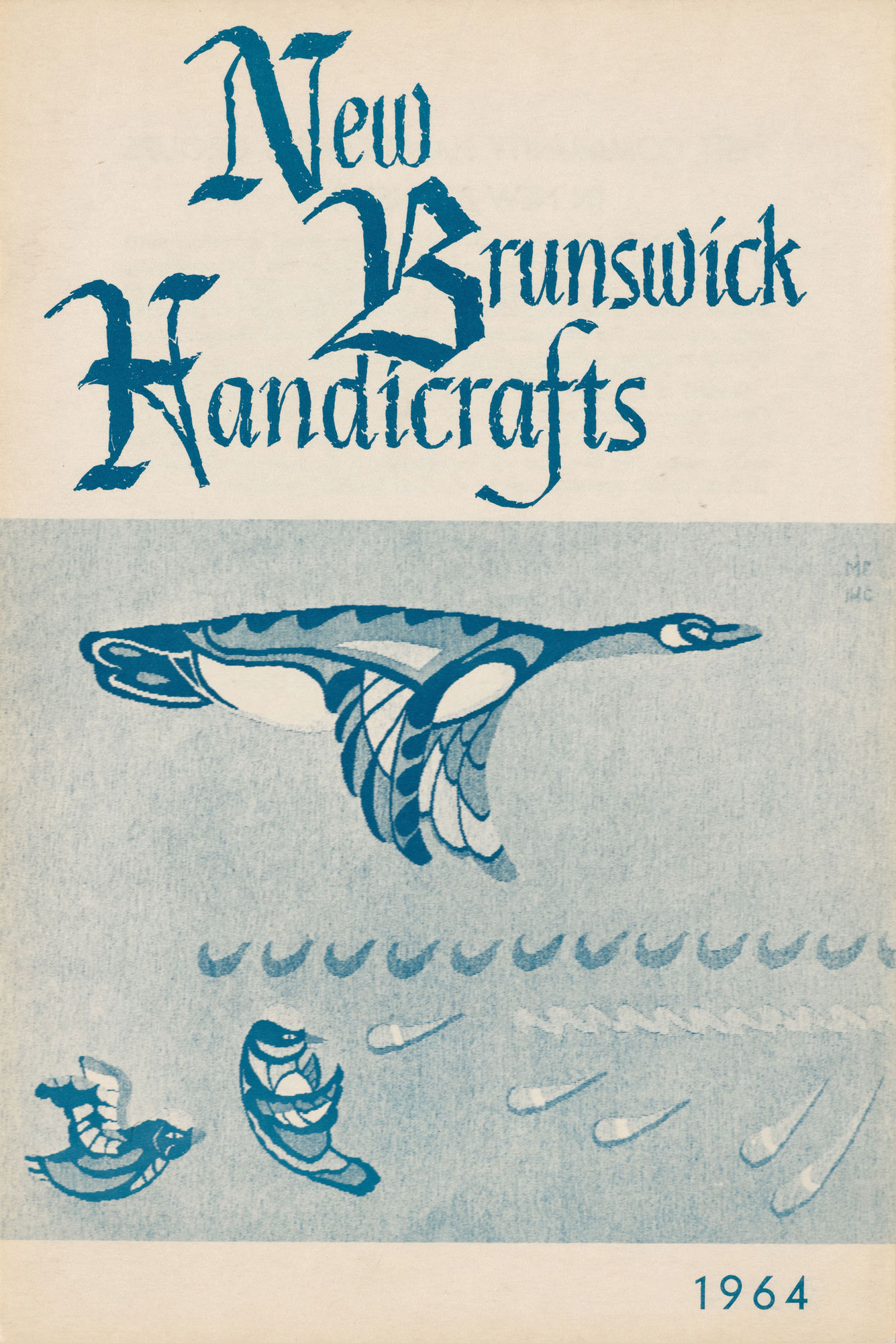
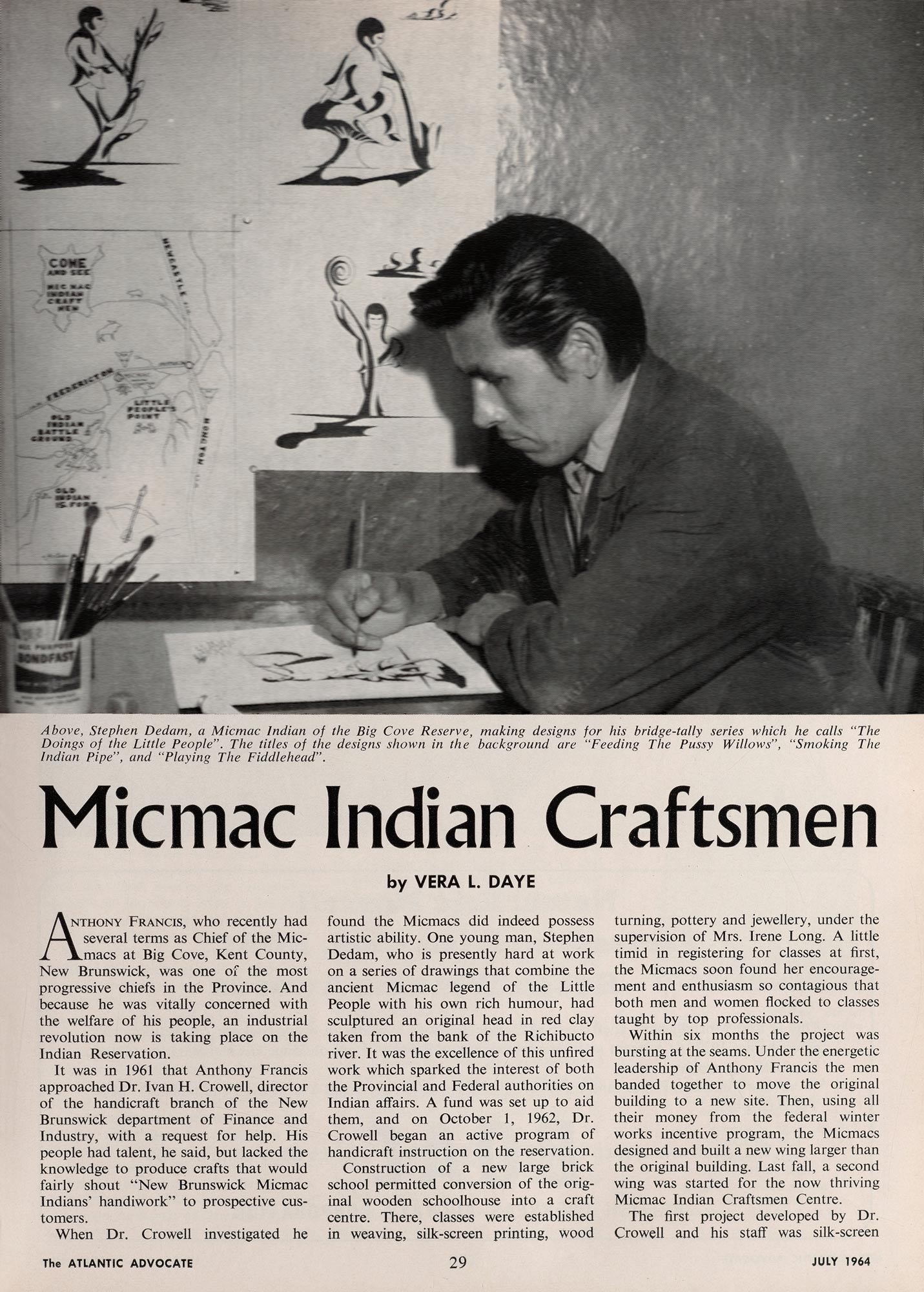
The spring and summer of 1964 seemed to be looking good for the MIC. They were “especially featured” at a general meeting of New Brunswick’s craftspeople (about three hundred at the time) in Fredericton on April 25, 1964. This year and next would also see their work featured as the cover image of both the 1964 and 1965 Blue Book of New Brunswick Craftsmen and Handicraft Shops. On-site tourist sales were up, and the July 1964 issue of the popular Atlantic Advocate magazine published a multi-page illustrated feature on Michael Francis, Stephen Dedam, and the MIC project. The magazine was virtually the Time or Maclean’s of Atlantic Canada, and the article would have been read by tens of thousands. An enormous boost for visibility and commercial interest, it championed the quality of work by Francis, Dedam, and other co-op members, although the article’s tone was latently racist and dismissive. Concurrently the Indigenous monthly, Indian Record, carried a shorter laudatory article that noted that, “Indian handicrafts and art, so long associated with baskets, bead and leather work, are undergoing a revolution at this Micmac settlement.”
Success was becoming measurable, if complex. By the end of December 1964, the workers at the MIC had silkscreened more than 300,000 Hasti-Note cards by hand in two years. At a general meeting held at Big Cove on January 7, 1965, with more than forty locals present, Crowell said that fifty to sixty percent of the outlets that had purchased from the MIC had re-ordered. This was a much higher rate than the twenty percent that most other New Brunswick handicraft studios saw.
It is interesting to note that there were still deep language and cultural barriers between the Mi’kmaq and the non-Indigenous people involved in the MIC. The minutes show that business formality wasn’t the community norm, and after the meeting ended, the locals present agreed to meet among themselves and to discuss many of the proposals in their own language.
No doubt a key concern was that after two years of design, making, and invention, the MIC workers were still poorly paid. Each twelve-card set retailed for ninety cents and wholesaled for fifty, while the makers received only thirteen cents per dozen. This was not considered enough to make the work worthwhile and may perhaps have been a major factor in the MIC’s declining output. At a meeting on March 8, 1965, an agreement was made to raise this amount to twenty cents per dozen. Women who had received two cents to pack each burlap bag of cards, would now earn four. The rate for silk screening the burlap remained a cent per bag.
Crafting a Place in the Public Imagination
In April 1965, the federal government asked the locals if they found the project worthwhile, and whether they wanted it to continue under the supervision of the province or they were ready to take over themselves. It was looking less and less likely that government support would continue.
That aside, the year 1965 would see continued commercial success and media accolades. The public reception for of the tapestry series on the UNB campus was enthusiastic, with the Daily Gleaner announcing, “Micmac Indians Are Excellent Designers, Superb Craftsmen.” The IODE again featured MIC images on their calendar, the 1966 version featuring the same images as the previous year.
-
Cover of New Brunswick, Canada: Motourland, provincial tourism booklet, c.1964.
-
Michael Francis (bottom right) featured in New Brunswick, Canada: Motourland, provincial tourism booklet, c.1964.
-
MIC silkscreened image of Glooscap riding a whale from the school textbook New Brunswick: The Story of our Province (W.J. Gage, 1965).
The calendar wasn’t the only MIC item to make it into schools. The year 1965 also saw the publication of a handsome history textbook for all of New Brunswick’s Anglophone grade 5 and 6 classes titled New Brunswick: The Story of our Province. Published by W.J. Gage, it prominently featured the MIC. Dr. George MacBeath (director of the New Brunswick Museum) and Dorothy Chamberlin were the authors, and their illustrated volume showed a marked shift from previous textbooks that were disdainful of Indigenous history.
By contrast, the Gage textbook featured a substantial and respectful first chapter on the social and material culture of the Algonkians, along with stories of Glooscap and a near full-page illustration by Michael Francis of the hero riding a whale. The end of the textbook featured a photograph of Francis working, the caption stating that “the artistic talents of Indians like Michael Francis on the Big Cove Micmac reserve have taken on a new purpose.” A mid-1960s edition of the provincial tourist guide also featured Francis working on MIC paintings. His was the only image of a craftsperson in the book. For a province that took its fine craft seriously, this was heady recognition.
National bodies were starting to pay more attention to the growing interest in “Indian crafts.” The federal Department of Forestry commissioned a substantial study in 1966 with the goal of establishing a program to develop future markets. This made sense on many levels. By 1963, nineteen Indigenous art/handicraft co-operatives were active across Canada, with a total annual business turnover of nearly a million dollars. What did not make sense was the federal and provincial governments’ eventual abandonment of the MIC.
Storytelling as the Preservation of Mi’kmaw Knowledge
What captured art collectors’ attention in the MIC’s work (aside from the striking graphics) were the stories that accompanied each piece and the sense of community contribution to their production. Big Cove / Elsipogtog was and is home to many talented artists and storytellers, and the MIC represented more than an economic enterprise. It exemplified a moment in their history when the community worked toward a common good. To the governmental bodies, perhaps the MIC represented unfulfilled economic promise. Still, for the Mi’kmaq of Big Cove / Elsipogtog, while it lasted it was a successful means of sharing knowledge. They held onto their memories, and their work contained Mi’kmaw Oral Stories, cultural histories, and knowledge of the non-humans that inhabit the land and sea.
Beyond the skilled art and designs of the MIC, the stories themselves were central to the products that came out of their studio. The stories embodied Wabanaki values and worldviews and connected to events that took place over the course of the MIC’s successes and pitfalls.
At Big Cove in the 1920s and 1930s, Michael Francis grew up listening to his grandfather tell stories about “giants and reptiles and witches and the Great Spirit.” It was their primary source of entertainment, but these stories also carried important life lessons and teachings. They were inscriptions of our obligations, relationships, and histories on this earth.
Considering storytelling as theory and methodology, Chief David Walkem and members of Cook’s Ferry Nlaka’pamux First Nation in British Columbia believe “the most important qualities of our culture are our language and our stories. In oral traditions such as ours, telling stories is how we pass on the history and the teachings of our ancestors. Without these stories, we would have to rely on other people for guidance and information about our past.”
Storytelling is foundational learning and teaching. In oral cultures, storytelling sustains cultures and communities and their worldviews. Story, says Judy Iseke, who played a key role in reviving the Michif language, validates one’s personal experiences and nurtures relationships and sharing of teachings. Storytelling functions as both witnessing and remembering past events, and our engagement to the storyline allows us to learn more about ourselves. Story, like language, reveals certain aspects of our identity—teachings, lessons, warnings, how to problem solve, and how to use our imagination. She notes that colonization forces us to “remake” ourselves, and our nation’s stories can aid in putting the pieces back together. In short, parts of our collective identities and histories are embedded in story.
In storytelling, we can become who we are meant to be. The stories we tell of who we are, where we come from, what we understand, and how we belong, what we make ourselves and our connections to our world. Through storytelling and ceremonial life, we are involved in the lifeways of a people, culture, community, family, and tradition, and in it we make a new story today of our connections. Whether our stories are pedagogical or witnessing and therefore have a teaching function, or ceremonial and have a spiritual connection, the stories are important to our cultural life.
In Wabanaki cultures, like many Indigenous societies, stories and Oral Histories are in line with the truth, revealing values, teachings, and worldviews. The English words “myth“ and “legend“ do not bear enough weight and meaning to describe traditional stories as they are meant to be told and understood. Unfortunately, Indigenous Peoples already bear the brunt of using English words to explain themselves within the framework of their cultures. Therefore, it is imperative to use stories as part of methods of making and study, and to honour Elders’ teachings that uphold our knowledge systems.
MIC designers Michael Francis, Stephen Dedam, Michael Dedam, and Vincent Barlow ensured that future community members, Wabanaki citizens, would have access to the stories they used in their artistic depictions. Storytelling encourages a broader understanding of the self, spirit, spirit world, community, culture, relations, and identity (especially when stories are told and understood in their original language). Like language and art, story can help us rebuild or remake ourselves in ongoing colonial settings.
 About the Authors
 More Online Art Books
 Acknowledgements